Tegalalang Rice Terrace 2026: Rp 25,000 Entry, 7 Best Photo Spots — by Certified Bali Guide
Certified Bali guide's 2026 walkthrough of Tegalalang Rice Terrace — Rp 25,000 entry fee, 7 photo spots, swing prices, drone rules, and Tegalalang vs Jatiluwih vs Sidemen compared.
In This Guide
- Table of Contents
- What is Tegalalang Rice Terrace
- Where exactly is it
- How to get there
- Tegalalang 2026 prices
- Tegalalang vs Jatiluwih vs Sidemen
- Best time to visit
- Best photo spots
- What to do at Tegalalang
- Local guide tips
- FAQ
- What is Tegalalang Rice Terrace famous for?
- How much does it cost to enter Tegalalang Rice Terrace in 2026?
- How long do you need at Tegalalang?
- Is Tegalalang Rice Terrace worth visiting?
- Tegalalang vs Jatiluwih — which should I visit?
- What is the best time of day to visit Tegalalang?
- Can I visit Tegalalang Rice Terrace for free?
- Are drones allowed at Tegalalang Rice Terrace?
- Is the Bali swing inside the rice terrace?
- What month has the greenest rice at Tegalalang?
- Is Tegalalang Rice Terrace accessible for families with kids?
- Where should I base myself to visit Tegalalang easily?
- Is Tegalalang really part of UNESCO?
- Related Guides
Plan your Tegalalang day in 60 seconds: use our Bali Region Picker to confirm Ubud is the right base, then run your route through the Bali Distance Calculator to see exact drive times from Canggu, Seminyak, or the airport. Both are free and built by us.
Quick answer (2026): Tegalalang Rice Terrace (also called Ceking Rice Terrace) sits 9 km north of Ubud. Entry is Rp 25,000 per person (~$1.60 USD), cash only, paid at the main gate. Open daily 7:00 AM to 6:00 PM. Best photo time: 7:00–9:00 AM for soft side-light and zero tour buses. Compared to Jatiluwih (UNESCO, Rp 40,000, 1h 45min from Ubud), Tegalalang is the dramatic short stop; Jatiluwih is the full-day experience.
Why this guide is different. I am part of a family of certified Bali guides — my wife is a licensed French and Mandarin-speaking guide, her parents are official Mandarin guides, and we have lived in Bali for years after relocating from Medan, Indonesia. We take guests to Tegalalang almost every week. This is not a 2019 listicle scraped from other blogs. Every fee, every timing, every warung tip below was checked on the ground in April 2026.
Tegalalang Rice Terrace is the most photographed rice paddy in Bali, and it is also the one visitors misunderstand the most. The reactions split into two camps: people who arrive at 11 AM with a tour bus and leave underwhelmed, and people who come early, walk the valley properly, and tell me later it was the highlight of their trip. This guide is for the second group.
Table of Contents
- What is Tegalalang Rice Terrace
- Where exactly is it
- How to get there from Ubud, Canggu, and Seminyak
- Tegalalang 2026 prices: full table
- Tegalalang vs Jatiluwih vs Sidemen
- Best time of day and year to visit
- 7 best photo spots
- What to actually do at Tegalalang
- Local guide tips most blogs miss
- FAQ
What is Tegalalang Rice Terrace
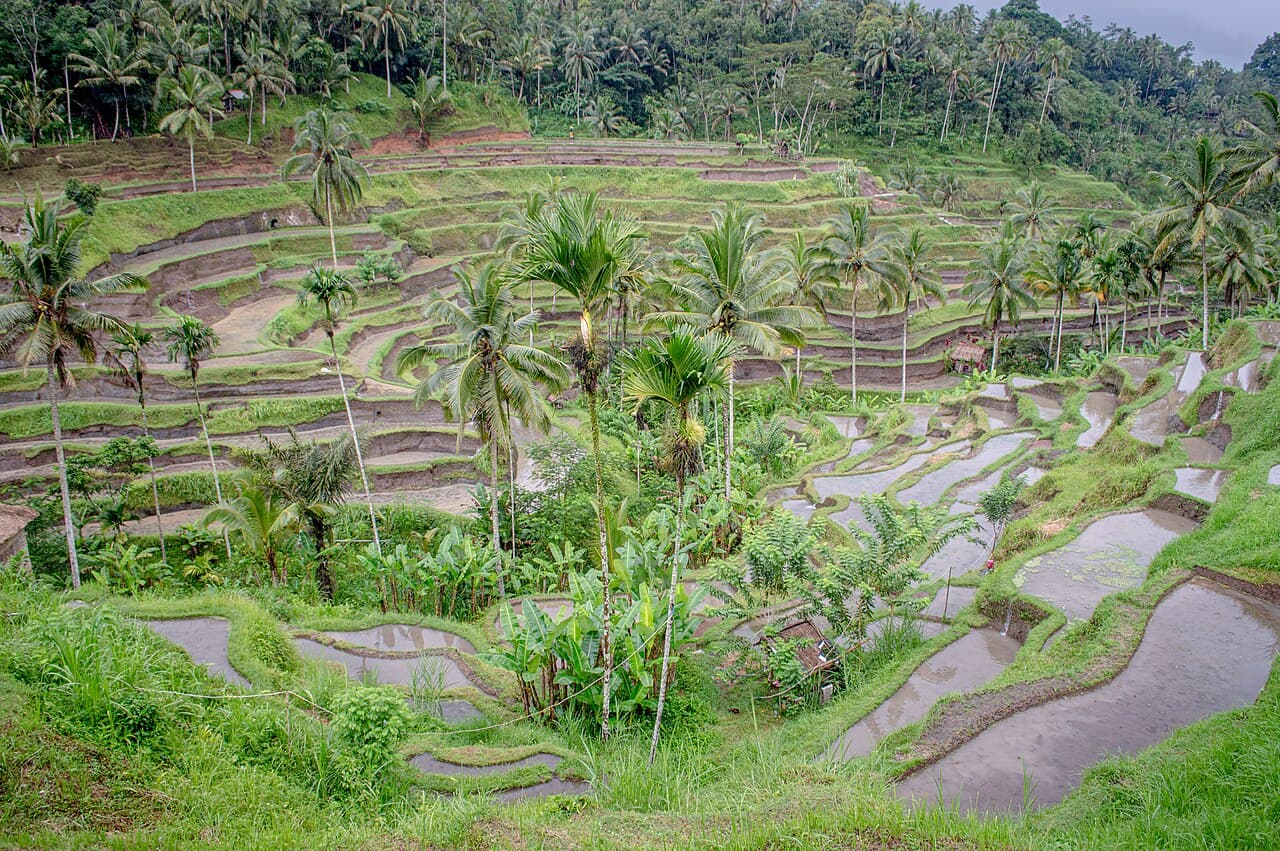
Tegalalang Rice Terrace — sometimes written as Tegallalang, signposted locally as Ceking Rice Terrace — is a steep, narrow valley of stepped rice paddies in central Bali. The paddies are actively farmed. They are not a film set. The water running through them is part of the subak system, a traditional Balinese cooperative irrigation network recognized as a UNESCO Cultural Landscape of the Province of Bali in 2012.
The viewpoint everyone photographs is about 600 meters long, on the west side of the Ceking valley. The terraces themselves continue much further south. Most visitors only see the upper third.
The site sits at roughly 600 meters elevation, which is why it is usually a few degrees cooler than the south of Bali and why afternoon clouds roll in fast. I will come back to that when we get to timing.
Where exactly is it
Tegalalang Rice Terrace is located in Tegallalang village, Gianyar Regency, on Jalan Raya Tegallalang, the main road running north from Ubud toward Kintamani. Coordinates: −8.4315, 115.2775.
Distances from the main tourist areas:
| From | Distance | Typical driving time |
|---|---|---|
| Ubud center | 9 km | 20–25 minutes |
| Canggu | 38 km | 1h 15 min – 2h 00 min |
| Seminyak | 41 km | 1h 30 min – 2h 15 min |
| Sidemen | 35 km | 1h 10 min – 1h 30 min |
| Denpasar airport (DPS) | 45 km | 1h 30 min – 2h 30 min |
Traffic on the Ubud ring road is the main variable. A 9 km trip from central Ubud can take 15 minutes at 7 AM or 45 minutes at 11 AM. If you want exact door-to-door times for your hotel, run them through the Bali Distance Calculator.
How to get there
The three realistic options are a private driver, a scooter, or a day tour. Ride-hailing apps like Gojek and Grab technically work for the trip up, but they rarely work for the return — local driver associations restrict app pickups in this part of Gianyar, and you will wait a long time or get cancelled repeatedly.
By private driver. This is what most of my guests choose. A half-day driver from Ubud costs around Rp 450,000–600,000 (~$29–$39 USD), and a full-day driver combining Tegalalang with other Ubud-area sights runs Rp 700,000–900,000 (~$45–$58 USD). Hiring a private driver also lets you stop anywhere on the way back, which is where the best photos usually happen — the road between Tegalalang and Ubud passes several smaller, quieter terraces that nobody visits.
By scooter. If you are comfortable on a motorbike, the ride from Ubud is straightforward and takes 25 minutes. Parking at Ceking is Rp 5,000. I only suggest this if you have already ridden in Bali for a few days. The road is winding, busy with tour vans, and has blind corners.
By day tour. Group tours drop you at the main viewpoint for 30–45 minutes, usually around 10 AM. You will be in the middle of the largest crowd of the day. If you want a structured visit without the bus-tour rush, our private day tours cover Tegalalang, Tirta Empul, and a waterfall in one route.
Tegalalang 2026 prices
Every fee below was paid or verified by us in April 2026. Cash only — there is no card terminal at the gate.
| Item | Price (IDR) | USD (approx) | Notes |
|---|---|---|---|
| Adult entry | Rp 25,000 | $1.60 | Per person, paid at main gate |
| Child entry (under 5) | Free | – | – |
| Donation boxes (path) | Rp 10,000–20,000 | $0.65–$1.30 | 2–3 boxes along the loop, optional but how the path stays open |
| Car parking | Rp 10,000 | $0.65 | – |
| Scooter parking (official) | Rp 5,000 | $0.32 | Free at any warung if you order a drink |
| Coconut at interior warung | Rp 25,000–40,000 | $1.60–$2.60 | Worth it for the view |
| Bali coffee at interior warung | Rp 25,000–35,000 | $1.60–$2.30 | – |
| Photo swing (basic, single seat) | Rp 150,000–250,000 | $9.70–$16 | One photo, no harness, no staff photographer |
| Aloha Ubud Swing (premium) | Rp 300,000–600,000 | $19–$39 | Includes harness, staff photographer, several swings |
| Zen Hideaway swing | Rp 350,000 | $23 | Bamboo platform, queue can be 30+ minutes |
| Drone fee (commercial) | Rp 200,000–500,000 | $13–$32 | Ask at the gate; recreational drones are tolerated before 9 AM |
| Sarong rental (if needed) | Rp 20,000 | $1.30 | Not required for the terrace itself |
A tip about the swings: they are not inside the rice terrace. Every operator is on an adjacent ridge. If you only want the Instagram photo with the green valley behind you, the cheap photo swings give you the same background as the expensive ones. The difference is safety harnesses, wait time, and whether a staff photographer is included. I generally tell guests the swings are overrated if they are the main reason you came. They are fine as a 20-minute add-on after you have walked the actual terrace.
Tegalalang vs Jatiluwih vs Sidemen
People search for all three. They are not interchangeable. Here is the honest comparison after taking guests to all of them:
| Factor | Tegalalang | Jatiluwih (UNESCO) | Sidemen |
|---|---|---|---|
| Location | Ceking, near Ubud (Gianyar) | Tabanan regency, central-west | Sidemen valley, east Bali |
| Drive from Ubud | 20–25 min | 1h 45min – 2h 15min | 1h 10min – 1h 30min |
| Entry fee 2026 | Rp 25,000 | Rp 40,000 | Free (working farmland) |
| Size | ~0.6 km main viewpoint, narrow valley | ~600 hectares, rolling open fields | Open valley, no fixed boundary |
| UNESCO recognized | Yes (subak system, 2012) | Yes (subak system, 2012) | No |
| Crowds (April 2026) | High after 9:30 AM | Low even midday | Almost none |
| Scenery | Dramatic, vertical, photogenic | Expansive, pastoral, panoramic | Lush valley framed by Mt Agung |
| Walking trails | 1 short loop (1.5 km) | 5 marked trails (1.5–8 km) | Informal paths through villages |
| Swings / Instagram setups | Yes (lots) | No | No |
| Best for | Quick visit, photos, first-timers | Hiking, solitude, repeat visitors | Authentic farmland, photographers, slow travel |
| Time needed | 90 min – 2h | Half to full day | Half day minimum |
My honest take: Tegalalang is more dramatic and better for a short stop; Jatiluwih is a more honest experience of Balinese rice country; Sidemen is what Ubud looked like 20 years ago. If you have a 7-day Bali itinerary, visit Tegalalang early in your trip, Jatiluwih on a dedicated day from Ubud (combine with Ulun Danu Beratan and a Munduk waterfall), and add Sidemen as a 2-night base on your way to east Bali.
Best time to visit
Best time of day: arrive at 7:00–7:30 AM. The gate opens at 7 AM. From 7 to roughly 9 AM, you will have soft side-light on the terraces, few other visitors, and cool air. The first tour buses arrive around 9:30–10:00, and by 11 AM the main viewpoint is packed.
Second best window: 3:30–5:30 PM, if the day has been clear. Afternoon light is warmer but clouds often roll over the valley after 2 PM in the wet season.
Worst time: 11 AM to 2 PM. Harsh overhead sun flattens the photos, the terrace path is hot and exposed, and you will share every ledge with a tour group.
Best time of year: the terraces are green all year because they are irrigated, but the color changes through the rice cycle.
| Month | Typical look at Tegalalang | Photo verdict |
|---|---|---|
| January | Mid-growth green | Good, expect rain |
| February | Tall bright green | Excellent |
| March | Golden / harvest | Best for "postcard Bali" |
| April | Post-harvest, water + seedlings | Reflective, different look |
| May | Fresh green | Excellent |
| June | Mid-growth green | Excellent |
| July | Tall green | Excellent |
| August | Pre-harvest green-gold | Excellent (peak crowds) |
| September | Golden / harvest | Best for postcard look |
| October | Post-harvest, water + seedlings | Reflective |
| November | Mid-growth, green again | Good |
| December | Mid-growth, wet | Variable, expect rain |
Rice cycles vary paddy by paddy at Tegalalang, so there is almost always something green somewhere. If you want a specific look, ask your guide which fields are at which stage that week — we check this constantly.
Want us to plan this trip for you?
Our certified guide will create a personalized itinerary based on your interests, pace, and travel style.
Get Your Free ItineraryFor a broader weather overview, see our guide to Bali's rainy season and the best time to visit Bali.
Best photo spots
Most blogs send you to the main entrance platform and call it done. There are seven distinct photo spots, and the best one is not the obvious one. Numbered in the order you will reach them on the standard west-side loop:
- Main entrance platform. The wide overlook 30 meters past the ticket gate. Classic postcard angle but the most crowded.
- Lower west-path bend. About 200 meters down the path, where the trail bends sharply right. Looking back up gives you layered paddies framing the descent.
- Bamboo footbridge (the best one). At the bottom of the loop. Stand on the bridge facing back up the valley. The terraces tier toward you in every direction. This is the spot most blogs miss.
- East ridge unmarked path. A small unmarked dirt path climbs the east side from near the bridge. Three minutes up, almost no other visitors, and the view back across the terrace is the cleanest angle in the whole place.
- Warung middle deck. The interior cafés have a small terrace seat tucked into the rice. Order a coconut, sit, and shoot through the bamboo frame.
- North platform near the gate (sunrise pocket). A small unsigned platform 50 meters left of the entrance. At 7 AM the rising sun grazes the top tier — best low-angle light of the morning.
- The road bend at the southern end. Walking back to the road from the bridge, there is a small lay-by with a clean view of the lower terraces and almost no one stopping there.
For drone shots, the cleanest line is the south-to-north pull-back from above the bamboo footbridge, before 9 AM. Stay below 50 meters and avoid flying over the warungs.
What to do at Tegalalang
Most visitors stay 30 minutes. The terrace deserves 90 minutes to 2 hours if you are going to come all this way.
Here is what I actually suggest, in order:
- Walk the full west-side path. From the main entrance, follow the path down and south. It descends into the valley, crosses a footbridge, and climbs back up the east ridge. The full loop is roughly 1.5 km and takes 45–60 minutes at a slow pace with photo stops. Wear grippy shoes — the steps are slippery when wet.
- Stop at a warung in the middle of the terrace. Two or three small family-run cafés sit partway down the west side. Order a fresh coconut or a Bali coffee. You are sitting in the middle of a working rice paddy. Take five minutes and do nothing. This is the point.
- Look for the irrigation channels. The subak water system is engineered cleverly — look at how water steps from one level to the next through small wooden or bamboo gates. The channels are ancient in concept; the engineering is genuinely elegant. No guidebook explains this well because you have to see it.
- Skip the giant "I LOVE BALI" sign. It is a fake swing platform with a 45-minute queue for a photo that looks like every other photo on Instagram.
- Add one of the hidden viewpoints on the east ridge. If you have time, walk up the east side of the valley (small unmarked path near the bottom of the loop). Far fewer people, and the view back across the terrace is the best angle in the whole place.
- Add a half-day around it. A Balinese cooking class in Ubud after the morning visit pairs well — most schools start at 11 AM and end with a long lunch.
Local guide tips
A few things I only share with guests once we are at the terrace:
- Donation boxes are real. The little wooden boxes along the path are placed by the farmers whose land you are crossing. Drop Rp 10,000–20,000 in two or three of them as you walk through. Without this, the path privileges slowly disappear — a few sections were already closed off in 2024 because visitors stopped contributing.
- The best photo spot is the bamboo footbridge at the bottom of the loop, not the main viewpoint at the top. Look back up the valley.
- There is no real shade on the upper platforms. Bring a hat. Water is sold inside but at tourist prices — fill a bottle before you leave Ubud.
- Scooters can be parked for free at any warung on the main road if you order something. Save the parking fee.
- Signal is weak in the valley. Download offline maps. This matters more than it sounds — the path is not always obvious.
- Drones are tolerated before 9 AM but actively discouraged after that, especially over the warungs. Commercial shoots need a permit at the gate.
- Combine it with a waterfall, not another tourist stop. Drive 25 minutes further north to Tegenungan or Tibumana waterfall for a swim before lunch. See our list of the best waterfalls in Bali.
- Don't wear white. The paths are red volcanic clay. You will get them dirty. Everyone does.
For a full day plan, we usually combine Tegalalang with other things to do in Ubud — Tirta Empul for the water purification ritual, a Bali temple visit, a coffee plantation stop, and lunch at a traditional warung in Penestanan. Morning rice terraces, midday ritual, afternoon coffee, and you are back in Ubud before the afternoon traffic builds up.
FAQ
What is Tegalalang Rice Terrace famous for?
Tegalalang Rice Terrace is famous for its dramatic vertical layout of stepped rice paddies and its traditional Balinese subak irrigation system, which has been used for over a thousand years and was recognized as a UNESCO Cultural Landscape in 2012. It is the most photographed rice terrace in Bali, mainly because of its proximity to Ubud and its photogenic shape.
How much does it cost to enter Tegalalang Rice Terrace in 2026?
Entry to Tegalalang Rice Terrace is Rp 25,000 per person (~$1.60 USD) in 2026, paid in cash at the main gate. Expect additional small donations of Rp 10,000–20,000 for the farmers who maintain the walking paths, plus parking fees of Rp 5,000 for scooters or Rp 10,000 for cars. Cash only — there is no card terminal.
How long do you need at Tegalalang?
Plan 90 minutes to 2 hours if you want to walk the full valley loop and enjoy a drink at one of the interior warungs. A rushed visit to only the main viewpoint takes about 30 minutes, but you will miss the most interesting angles and the quieter sections of the terrace.
Is Tegalalang Rice Terrace worth visiting?
Yes, Tegalalang Rice Terrace is worth visiting if you arrive early (before 9 AM), walk the full loop, and accept that some parts near the entrance are touristy. It is one of the most accessible UNESCO-recognized rice landscapes in the world and only 25 minutes from Ubud. Visitors who come at midday with a bus tour are often disappointed — timing is the whole game.
Tegalalang vs Jatiluwih — which should I visit?
Visit Tegalalang if you have limited time, are based in Ubud, and want a dramatic short stop (Rp 25,000, 25 minutes from Ubud). Visit Jatiluwih if you prefer a full-day experience, enjoy hiking, and want fewer crowds (Rp 40,000, 1h 45min from Ubud). Jatiluwih covers roughly 600 hectares, has five marked trails, and receives a fraction of the visitors.
What is the best time of day to visit Tegalalang?
The best time is between 7:00 and 9:00 AM, right after the gate opens. You get cool air, soft morning light, and very few other visitors. The main viewpoint becomes crowded after 9:30 AM as tour buses arrive, and the midday heat between 11 AM and 2 PM is uncomfortable without shade. Second-best window is 3:30–5:30 PM when the light turns warm.
Can I visit Tegalalang Rice Terrace for free?
No, the main viewpoint and the walking path inside Tegalalang Rice Terrace require the Rp 25,000 entry fee. You can photograph the terrace from the road without paying, but the road-side angle is crowded, has no walkable access, and does not include the descent into the valley — which is the best part.
Are drones allowed at Tegalalang Rice Terrace?
Recreational drones are tolerated before 9 AM, before the crowds and tour buses arrive. After that, staff actively discourage flying over the warungs and the swing platforms. Commercial shoots need a permit, typically Rp 200,000–500,000 negotiated at the gate. Always stay below 50 meters and never fly directly over visitors.
Is the Bali swing inside the rice terrace?
No. None of the famous Bali swings are inside Tegalalang Rice Terrace itself. They are operated on adjacent ridges by separate businesses (Aloha Ubud Swing, Zen Hideaway, and several smaller photo swings). Prices range from Rp 150,000 for a basic single-seat photo swing to Rp 300,000–600,000 for premium operators with safety harnesses and staff photographers.
What month has the greenest rice at Tegalalang?
The greenest, tallest rice is typically in February, May–June, and August, about 6–8 weeks before harvest. March and September are harvest months when the paddies turn golden — the most "postcard Bali" look. Right after harvest (parts of April, October, December), the fields are reflective water with new seedlings, which is also beautiful but a different aesthetic.
Is Tegalalang Rice Terrace accessible for families with kids?
Tegalalang is manageable with kids over 5 who are comfortable walking, but the path has steep steps, uneven ground, and slippery sections after rain. Strollers are not workable. For families with younger children, Jatiluwih's flatter trails are easier. See our full Bali with kids guide for more family-friendly itineraries.
Where should I base myself to visit Tegalalang easily?
Stay in Ubud — it is 9 km from Tegalalang and the best base for the entire central Bali region (Tegalalang, Tirta Empul, monkey forest, Mt Batur). If you are unsure where to base your whole trip, run our Bali Region Picker — it matches Ubud, Canggu, Seminyak, Sidemen, and others to your travel style.
Is Tegalalang really part of UNESCO?
Yes — but not as a standalone site. Tegalalang's subak irrigation system is part of the broader UNESCO Cultural Landscape of the Province of Bali, inscribed in 2012. The full inscription covers five sites including Pura Taman Ayun, Pakerisan watershed, Catur Angga Batukaru, and the Royal Water Temple. Jatiluwih is the most-visited UNESCO-listed terrace; Tegalalang the most photographed.
Planning a trip? We are a family of certified guides — fluent in English, French, and Mandarin — who actually live in Bali and take visitors to Tegalalang every week. If you want someone who will time your visit properly, skip the tour-bus crowd, and add the overlooked stops around it, get in touch or send us your dates and we will map out a proper day.
Cover photo: "Tegallalang Rice Terraces Bali" via Wikimedia Commons, licensed under CC BY 4.0.
Related Guides
<!-- internal-link-sweep:2026-04-29 -->
Certified Travel Guide & Co-Founder
A certified Bali guide credentialed by the Indonesian Ministry of Tourism, fluent in French, Mandarin, English, and Indonesian. Part of a family of certified guides who have been guiding travelers across Bali for many years — sharing temples, rice terraces, and hidden corners that never make the brochures.
Languages: French · Mandarin · English · Indonesian
Ready to discover Bali?
Tell us about your dream trip and our local experts will craft a personalized experience just for you.
Start Planning