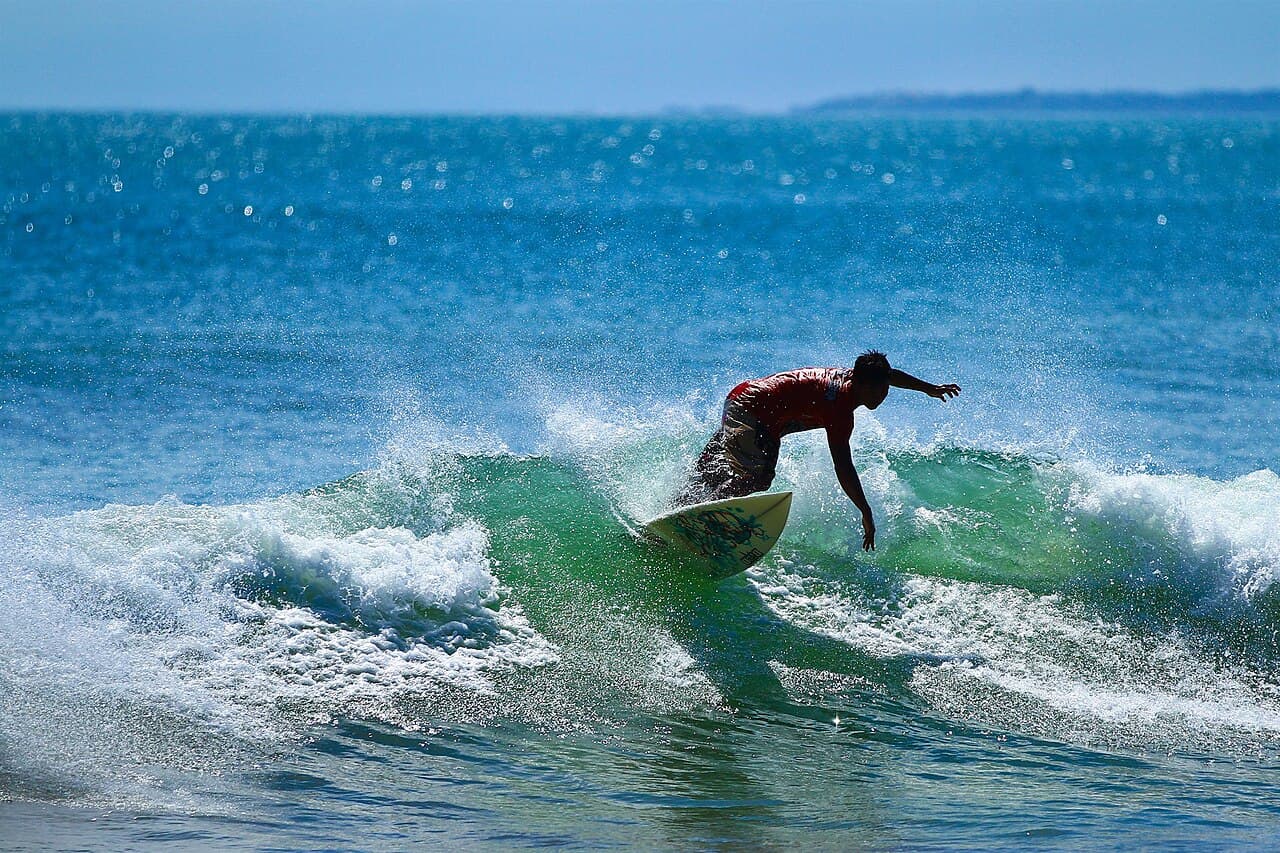
Quick answer: Kuta is Bali's most famous beach district — a long, lively stretch of sand on the southwest coast, just 15 minutes from Ngurah Rai International Airport. It is the cheapest and most accessible beach base on the island, known for beginner-friendly surf, budget nightlife along Jalan Legian, Waterbom Park, and dramatic sunsets. Best visited April to October. Stay 1–2 nights — Kuta works better as an arrival/departure base than a long stay. Choose Seminyak for upscale dining or Sanur for a quieter family beach.
Kuta is where modern Bali tourism began. In the 1970s it was a sleepy fishing village whose surf-friendly waves drew Australian board-riders looking for cheap rooms and warm water. Five decades later, Kuta has become the most developed and most divisive destination on the island — a packed grid of hotels, surf shops, warungs, mega-clubs, and tour operators stretching back from a beach that still produces some of the best sunsets in southeast Asia. As a family of certified Bali guides, we are honest with our clients: Kuta is not for everyone. If you want quiet luxury, choose Seminyak or Sanur. If you want jungle and culture, head to Ubud. But if you want cheap surf lessons, easy airport access, and the kind of nightlife where nobody asks where you are from, Kuta still does it better than anywhere else on the island.
Kuta Beach
Kuta Beach is the longest stretch of sand in southern Bali — over 4 kilometers of soft, light-grey sand running from Tuban (near the airport) up through central Kuta to Legian and on toward Seminyak. The beach is wide at low tide, sloping gently into the Indian Ocean, with consistent waves that have made Kuta the surf school capital of Bali. Unlike the dramatic cliffs of Uluwatu or the volcanic black sand further north, Kuta is the classic tropical beach experience: bright, broad, and busy.
The beach is publicly accessible along its entire length, with formal entrances every few hundred meters. There are no entrance fees, but you will pay 10,000–20,000 IDR (less than US$2) for a sun lounger and umbrella from local vendors. Massage ladies, fresh-fruit sellers, and surfboard renters work the sand all day. Bargain politely — initial prices are usually doubled.
Sunbathing and swimming — The water is warm (27–29°C / 80–84°F) year-round and shallow for the first 20–30 meters before dropping off. Lifeguards staff the main central section during daylight hours, and red-and-yellow flags mark the safest swimming zones. Pay attention: rip currents are real, and the surf can build up faster than you expect. If lifeguards close a section of the beach, do not swim there.
Sunset on Kuta Beach — This is the experience that defines a visit. From around 5:30 pm in the dry season, locals and travelers gather on the sand with a Bintang or a coconut to watch the sun sink into the ocean. The light is extraordinary — golden, then pink, then a deep red that backlights the silhouettes of surfers paddling in. Beachfront warungs put out plastic chairs and bamboo mats; the atmosphere is informal and democratic. You do not need a reservation, a dress code, or a fat wallet to see one of the best sunsets of your life.
Surfing in Kuta
Kuta is the easiest place in Bali to learn to surf, and one of the easiest in the world. The waves are sandy-bottomed (no reef cuts), break consistently, and roll in at a beginner-friendly size for most of the year. Generations of travelers have caught their first wave here.
Surf schools — There are dozens of operators along the beach. Reputable ones include Odyssey Surf School, Pro Surf School, and Rip Curl School of Surf, but most beach-vendor lessons are also fine if the instructor is in the water with you. A 2-hour group lesson typically costs 350,000–500,000 IDR (US$23–33) including board, rashguard, and instructor. Private lessons run 600,000–900,000 IDR (US$40–60). Most students stand up on their first session.
Board rentals — Once you can paddle out independently, soft-top and hard-board rentals are widely available at 100,000–150,000 IDR (US$7–10) for a half day, or 150,000–200,000 IDR (US$10–13) for a full day. Bargain on multi-day rentals.
Best months for beginners — April through October (dry season) brings cleaner, smaller waves in the morning. June, July, and August can produce overhead swells that are too large for first-timers — book early-morning sessions when the waves are still glassy. November to March (wet season) has smaller, mushier waves that are also fine for learning, with rain showers that usually pass within an hour.
Where to surf in Kuta — The beach has multiple peaks. Beginner schools mostly use the central section near Hard Rock Hotel. More confident surfers paddle further south toward Tuban or north toward Legian Beach for longer rides. Halfway Kuta (between Kuta and Legian) is a popular intermediate spot.
Things to Do in Kuta
Beyond the beach, Kuta offers a tight cluster of family-friendly attractions, shopping, and one site of historical importance.
Waterbom Park — Consistently ranked among the best water parks in Asia, Waterbom is a serious destination in its own right. The park covers nearly 4 hectares of landscaped jungle with 22 slides ranging from the gentle Lazy River to the near-vertical Climax. A full-day adult ticket costs around 700,000 IDR (US$47); children's tickets are roughly half. The park is exceptionally well-maintained, with multiple food outlets, lockers, and shaded loungers. Plan a full day — arrive at opening (9 am) to beat both crowds and afternoon heat.
Beachwalk Shopping Center — A modern open-air mall directly across from Kuta Beach, Beachwalk is the most polished shopping experience in the area. Anchor stores include international fashion brands, a large supermarket, and a multiplex cinema. The food court offers relief from the heat and a more curated selection than the average street warung. Free wifi, clean bathrooms, and air-conditioning make it a useful midday refuge.
Bali Bombing Memorial — On Jalan Legian, a few minutes' walk from the central beach, stands the memorial to the 202 people killed in the 2002 nightclub bombings. The white stone monument lists the names of victims from more than 20 countries. It is a quiet, dignified place, and a reminder that Kuta's contemporary tourism scene exists in the shadow of a real historical event. We always encourage visitors to stop by — it takes 10 minutes, and it is part of understanding the destination.
Vihara Dharmayana Kuta — A small Chinese-Balinese Buddhist temple tucked behind the main street, often overlooked. Worth a 15-minute visit if you appreciate quiet religious sites. Free entry, modest dress required.
Kuta Art Market (Pasar Seni Kuta) — A covered market selling sarongs, beach dresses, wooden carvings, and souvenirs. Bargain hard — initial prices are inflated by 200–300%. A reasonable final price is roughly 30–40% of the first quote.
Kuta Nightlife
Honest assessment: Kuta nightlife is loud, crowded, cheap, and aimed at young international travelers. It is not refined, and it does not pretend to be. If your idea of a good evening involves a cocktail menu and a sea view, head to Seminyak. If you want neon, EDM, and 50,000 IDR Bintangs, Kuta delivers.
Sky Garden — The most famous club in Kuta, occupying an entire building on Jalan Legian with multiple floors playing different genres (hip-hop, EDM, top 40). All-you-can-drink wristbands are heavily promoted. The crowd is overwhelmingly young, mostly Australian, and the atmosphere is high-energy. Cover charges vary; ladies often enter free.
Bounty Discotheque — A cavernous club designed to look like a pirate ship, blasting commercial dance music until dawn. It is unsubtle and proud of it.
Beach bars and warungs — More relaxed than the Jalan Legian clubs. Beachfront places put out bean bags on the sand, and the vibe shifts to acoustic music and reggae after dark. Sunset hour is the best time to settle in.
Be aware — Drink spiking happens occasionally in Kuta clubs. Watch your drink, do not accept opened drinks from strangers, and stay with your group. Take a registered taxi (Bluebird) or a Grab ride home rather than walking alone after midnight. Methanol-tainted homemade alcohol has caused fatalities in Bali — stick to commercial brands of beer and spirits.
Where to Stay in Kuta
Accommodation in Kuta is the cheapest in southern Bali, and the variety is enormous.
Budget (under 300,000 IDR / US$20 per night) — Hostels and basic guesthouses cluster on Poppies Lane I and Poppies Lane II — narrow alleys running between Jalan Legian and Kuta Beach Road. These are noisy, basic, and fine for one or two nights, especially for backpackers and surfers. Check reviews for cleanliness before booking.
Mid-range (400,000–1,200,000 IDR / US$27–80 per night) — A wide selection of three- and four-star hotels with pools, breakfast, and reliable air-conditioning. Areas like Kartika Plaza (south Kuta / Tuban) tend to be quieter than central Kuta and closer to the airport. Hotels facing Jalan Legian get noise from the bars below — request a back-facing room.
Upper mid-range (1,500,000–3,000,000 IDR / US$100–200 per night) — A few well-known international resorts including Hard Rock Hotel Bali (right on the beach in central Kuta) and Discovery Kartika Plaza Hotel (in Tuban). These offer beach access, multiple pools, and full resort service.
Where to avoid — Hotels directly above noisy bars on Jalan Legian. Cheapest rooms with no windows. Anywhere that does not have legitimate reviews on a major booking platform.
Side streets vs main strip — Side streets (Poppies, Benesari, Pantai Kuta back lanes) are quieter and often have better-value guesthouses with small pools and gardens. The main strip (Jalan Legian) is noisy until 3 am. We almost always recommend side-street stays unless our clients specifically want to be in the middle of the action.
Dining in Kuta
Kuta will not win culinary awards, but it does have honest local food, fresh seafood, and a useful concentration of international options.
Warungs — Local family-run eateries serve nasi goreng, mie goreng, gado-gado, and grilled chicken at 25,000–60,000 IDR (US$2–4) per dish. Warung Indonesia and Warung Murah are reliable longtime favorites. Avoid empty warungs at meal times; busy ones are busy for a reason.
Beachfront seafood — Cheap, fresh grilled fish and squid at the beachfront warungs, especially around sunset. Expect 80,000–200,000 IDR (US$5–13) for a full plate with rice and vegetables. The setting beats the food, but the food is good enough.
Beachwalk Mall food court — More curated than the street, with sushi, ramen, Indian, and Western options. Useful for picky eaters and families with young children. Meals 80,000–200,000 IDR (US$5–13).
Made's Warung — A long-running institution serving traditional Balinese set meals (nasi campur) in a more polished setting than a roadside warung. Prices around 100,000–250,000 IDR (US$7–17). Worth one visit.
International chains — Yes, Kuta has McDonald's, KFC, Starbucks, Hard Rock Cafe, and most of the global fast-food brands. Useful if you have been traveling for a while and want a familiar meal — no shame in that.
For higher-end dining, the rule is simple: take a 10-minute drive to Seminyak. Kuta's restaurants are honest and cheap, but the best food in southern Bali is up the coast.
Kuta vs Seminyak vs Legian
The three districts run continuously up the southwest coast — you can walk from central Kuta to central Seminyak in about 45 minutes along the beach — but each has a distinct character.
| Feature | Kuta | Legian | Seminyak |
|---|---|---|---|
| Vibe | Lively, budget, young | Mellow middle ground | Upscale, polished |
| Beach | Long sandy, busy | Long sandy, less crowded | Long sandy, more curated |
| Surfing | Best for beginners | Beginner / intermediate | Intermediate |
| Nightlife | Loud clubs, cheap drinks | Casual bars, live music | Beach clubs, cocktails |
| Dining | Warungs and chains | Mid-range, mixed | World-class, fine dining |
| Shopping | Markets, surf shops | Boutiques, surf brands | Designer boutiques |
| Hotel range | US$15–150 | US$30–250 | US$80–500+ |
| Best for | Backpackers, surfers, first night | Couples, mid-range travelers | Honeymooners, foodies |
| Traffic | Heavy | Moderate | Heavy in evenings |
| Distance to airport | 15 min | 20 min | 30 min |
A common itinerary among our clients is: 1 night in Kuta on arrival (close to airport, surf lesson), 2–3 nights in Seminyak (relaxed beach + dining), then move on to Ubud or Uluwatu. Legian is the best choice if you want one base that splits the difference.
Day Trips from Kuta
Kuta's central location in southern Bali makes it a workable base for exploring further afield, especially with a private driver for the day.
Uluwatu (45 minutes south) — Clifftop temples, hidden beaches, and the famous Kecak fire dance at sunset. Spend a full day combining Padang Padang Beach, Uluwatu Temple, and a clifftop seafood dinner at Jimbaran Bay on the way back.
Ubud (1.5 hours north) — Bali's cultural heart. Day trips work but feel rushed; consider an overnight stay if your schedule allows. Combine Tegallalang rice terraces, the Sacred Monkey Forest, and an Ubud lunch.
Tanah Lot (1 hour northwest) — Iconic sea temple built on a rocky outcrop, best at sunset. A half-day trip is sufficient.
Nusa Penida day trip — A long but unforgettable day. Fast boat from Sanur (45 minutes from Kuta) to Penida, full day touring Kelingking Beach, Broken Beach, and Angel's Billabong, then boat back. Expect a 14-hour day if done as a round-trip from Kuta.
Tegenungan Waterfall (1 hour northeast) — A jungle waterfall easily combined with an Ubud trip.
Mount Batur sunrise hike (2 hours northeast) — Pickup at 2 am, arrive Mount Batur, hike 2 hours up for sunrise, breakfast on the rim, descend, return to Kuta around 1 pm. A long but iconic Bali experience.
Practical Tips
Transport — Kuta is walkable in its central core, but the heat and traffic make longer distances uncomfortable. Use Grab or Gojek (ride-hailing apps) for short hops — fares are fixed and typically cheaper than street taxis. Bluebird is the only fully reliable taxi brand. Avoid unmarked "transport?" drivers who quote inflated prices and refuse to use a meter.
Scams to avoid — Inflated taxi fares (always insist on the meter or use Grab). Aggressive massage and braid sellers on the beach (a polite firm "no, thank you" works). Tour touts on Jalan Legian selling unnecessarily expensive day trips (book through your hotel or a reputable agency). Currency exchange offices with absurdly good rates that hide commissions — use authorized money changers like PT Central Kuta or BMC.
ATMs — Plenty available, but skimming has been reported. Use ATMs inside bank branches or hotels, not standalone units on the street. Cover the keypad when entering your PIN.
Safety after dark — Stay on well-lit streets, walk in groups, do not flash phones or jewelry, and keep your bag on the side away from the road (bag snatching from passing scooters happens). Most violent crime is rare; petty theft is the realistic risk.
Ocean safety — Always swim between the red-and-yellow flags. Rip currents pull strong, fast swimmers offshore in seconds. If caught in a rip, do not fight it — float, signal for help, and let the lifeguards reach you. Never swim drunk, never swim at night.
Scooter rental warnings — Tempting, cheap, and dangerous. Foreigners die on Bali roads every month, and travel insurance often does not cover unlicensed scooter accidents. If you must ride, wear a real helmet, carry an international driver's permit with motorcycle endorsement, and avoid riding at night or in the rain. We recommend hiring a private driver for day trips instead.
Wifi and connectivity — Reliable across hotels, cafes, and most restaurants. Local SIM cards (Telkomsel, Indosat, XL) are cheap and work well; pick one up at the airport on arrival.
For travelers who want the polish of Seminyak without leaving the area, our Seminyak guide covers what is just up the coast. For broader context on Bali safety, see our is Bali safe guide, and first-time visitors should read our Bali travel guide for first-timers. Surfers can dig into our dedicated Bali surfing guide for spots beyond Kuta. And if you are in Kuta specifically for the bars and clubs, our Bali nightlife guide covers the full island scene.
Kuta is the beating, imperfect heart of mass-market Bali tourism. It is loud, cheap, and crowded, but it is also where many travelers fall in love with the island for the first time — at sunset, on a soft-top board, watching the sky turn pink while a stranger hands them a cold beer. That is worth one or two nights of any Bali itinerary, even if you spend the rest of your trip somewhere quieter.