Bali Rainy Season 2026: Month-by-Month Reality (Local Guide)
Bali rainy season 2026 — month-by-month rainfall, temperature, and what each Nov–Mar month is actually like, written by a family of certified guides who live here year-round. Plus what to do, what to pack, and when to book.
In This Guide
- What Bali's Rainy Season Actually Feels Like
- The Daily Rhythm
- How Heavy Is the Rain?
- Bali Rainy Season 2026: Month-by-Month Reality
- Bali in November 2026
- Bali in December 2026
- Bali in January 2026
- Bali in February 2026
- Bali in March 2026
- Regional Weather: Where Rains the Most (and Least)
- Worst Days vs Best Timing: How We Schedule Around the Rain
- What to Do in Bali on Rainy Days
- Indoor / Sheltered Activities
- Activities the Rain Actually Improves
- The Real Advantages of Visiting in Wet Season
- Prices Drop 20–35 %
- Fewer Crowds
- Greener Landscapes
- Common Wet-Season Mistakes Travellers Make
- What to Pack for Bali's Rainy Season
- Who Should (and Shouldn't) Visit During Rainy Season
- Great For
- Think Twice If
- FAQ
- Should I avoid Bali from November to March?
- Are flights to Bali cheaper during rainy season?
- Will the roads flood?
- Can I surf during Bali's rainy season?
- Are hotels really cheaper during wet season?
- What should I pack for Bali's rainy season?
- Is "monsoon" the same as "rainy season" in Bali?
- Is rainy season dangerous?
- When exactly does Bali's rainy season start and end?
- Sources & Verification
- Related Guides
Quick answer: Bali's rainy season runs November through March, peaking December through February. Average rainfall is 300–400 mm per month in peak months. The typical day is dry from sunrise until early afternoon, with one 1–3 hour tropical storm between 1 PM and 5 PM, then clear evenings. Temperatures stay warm at 28–32 °C year-round. Many travellers actively prefer this season — landscapes are at their greenest, waterfalls peak, hotels drop 20–35 %, and crowds shrink outside the Christmas/New Year peak.
I live in Bali year-round. I am part of a family of certified French- and Mandarin-speaking guides — Indonesian, originally from Medan — and we have been driving guests across the island through every rainy season since we settled here. The "rainy season" you read about online and what we actually experience are quite different. This guide is what 2026 looks like, month by month, with the timing tricks we use to keep itineraries on track even in February.
The biggest misconception is that wet season means you cannot enjoy Bali. You absolutely can. You just need to plan your days around a predictable afternoon storm window — and once you know the rhythm, the trade-off (lower prices, fewer crowds, dramatic green landscapes) starts to look like a deal.
What Bali's Rainy Season Actually Feels Like
The Daily Rhythm
A typical wet-season day in Bali looks like this:
- 6 AM – 12 PM — bright sunshine, clear skies, warm and pleasant. This is the prime window for outdoor activities, temple visits, beaches, and rice-terrace walks.
- 12 PM – 1 PM — clouds start building. Humidity rises sharply. You can usually feel the storm coming.
- 1 PM – 4 PM (sometimes 5 PM) — the storm hits. It is heavy tropical rain, often with thunder and lightning. Streets in Canggu, Kuta, and parts of Denpasar can flood briefly.
- 4 PM – evening — the rain clears, the air feels fresh and cooler, and washed skies produce some of the most vivid sunsets of the year.
This pattern holds true around 70 % of days in November, December, and March, and around 60 % of days in January and February (when multi-day grey spells start appearing). It is almost never a full 24-hour washout — even the wettest days usually have a usable morning.
How Heavy Is the Rain?
Heavy. This is not European drizzle. When it comes, it comes hard — 30–50 mm in an hour is normal. Drainage is improving but still imperfect, so low-lying areas (parts of Canggu, Seminyak, and Kuta) flood briefly. The flooding drains within an hour or two, but it can disrupt mid-afternoon travel. Always carry a lightweight rain jacket. Every minimart sells disposable ponchos for around 10,000 IDR (about $0.65).
Bali Rainy Season 2026: Month-by-Month Reality
This is the table I would have wanted before my first wet-season trip. Rainfall figures are 30-year averages from BMKG (Indonesia's meteorology agency) for South Bali. North and central Bali (Munduk, Bedugul) get noticeably more.
| Month | Avg rainfall | Rainy days | Temp (day/night) | Humidity | What to expect | Verdict |
|---|---|---|---|---|---|---|
| November 2026 | 180–230 mm | 12–15 | 31 °C / 24 °C | 80 % | Shoulder month. Rain often skips a day or two. Beaches and Ubud both still feel sunny. | Excellent — closest to dry season pricing/weather mix |
| December 2026 | 280–340 mm | 17–20 | 30 °C / 24 °C | 82 % | Storms become daily. Christmas/NY week is the one wet-season price spike. | Mixed — avoid Dec 22 – Jan 5 unless you want crowds |
| January 2026 | 320–410 mm | 20–24 | 29 °C / 24 °C | 85 % | Wettest month. Multi-day grey spells appear. Some flooding in low areas. | For value-seekers only — cheapest of the year |
| February 2026 | 300–380 mm | 19–23 | 29 °C / 24 °C | 85 % | Still very wet but shorter storm windows than Jan. Manta-ray sightings peak at Nusa Penida. | Underrated — quietest month, lowest prices |
| March 2026 | 220–280 mm | 14–17 | 30 °C / 24 °C | 82 % | Rain tapers. Last week of March often feels like dry season. | Excellent — best risk/reward of the wet season |
A note on 2026 specifically: long-range BMKG forecasts suggest a near-neutral ENSO, which means a fairly typical wet season — not the heavy La Niña years (like 2021/22) and not the dry El Niño years (2023). Expect average to slightly-above-average rainfall, particularly in January.
For the full year-round breakdown including dry season, see our best time to visit Bali guide.
Bali in November 2026
Shoulder month. Rainfall averages 180–230 mm across 12–15 rainy days, but storms still skip 2–3 days a week and afternoons often clear by 4 PM. Daytime 31 °C, nights 24 °C, humidity around 80 %. Hotel pricing is already 15–20 % below August/September peaks. Best wet-season pick if you want close-to-dry-season weather at off-season prices.
Bali in December 2026
Storms become daily, with 280–340 mm of rain over 17–20 rainy days at 30 °C / 24 °C. The first three weeks are excellent value; Christmas through January 5 is the one wet-season price spike (matching dry-season rates). Rice terraces are vivid green. Surf is strong on the east coast (Keramas, Sanur). Avoid mid-December if street flooding in Canggu would ruin your trip.
Bali in January 2026
The wettest month. 320–410 mm of rain across 20–24 rainy days, often arriving as multi-day grey spells rather than the predictable afternoon storm window. Daytime 29 °C, nights 24 °C, humidity 85 %. Lowest hotel prices of the year (often 30–40 % below August). Choose January only if you value cost over weather and have indoor backup activities (cooking class, spa, museums in Ubud).
Bali in February 2026
Still wet but storms tighten back into the predictable afternoon window. 300–380 mm of rain across 19–23 rainy days, but manta-ray sightings peak at Nusa Penida (one of the few months they reliably appear). The quietest tourist month of the year — Ubud feels like a village, Canggu cafes have empty seats. Underrated for photographers, divers, and travellers wanting authenticity over weather.
Bali in March 2026
Rain tapers. 220–280 mm of rain across 14–17 rainy days. The last week of March often feels indistinguishable from dry season — sunny mornings, occasional brief storms, vivid landscapes still holding wet-season green. Best risk/reward in the entire calendar: dry-season weather at wet-season prices. Many returning travellers specifically target the last 10 days of March.
Regional Weather: Where Rains the Most (and Least)
Bali is small but the microclimates are real. South Bali gets the BMKG headline numbers; the rest of the island varies meaningfully:
| Region | Rainy-season character | Best for |
|---|---|---|
| Sanur, Nusa Dua | Sheltered east/south coast. ~15–20 % less rain than Canggu/Seminyak. Mornings stay clearer longer. | Beach time during wet season |
| Canggu, Seminyak, Kuta | Heaviest South-Bali rainfall. Some street flooding. | Cafes, surf lessons, nightlife |
| Ubud and Sidemen | Cooler (24–28 °C), greener, mistier. More frequent showers but landscapes are at their best. | Rice terraces, yoga, photography |
| Munduk, Bedugul, Kintamani | Highland — gets ~40 % more rain than the south. Cool nights (down to 18 °C). | Waterfalls, coffee plantations |
| Amed and the East Coast | Driest part of Bali. Receives 30–40 % less rain than Canggu. | Diving, snorkelling, quiet beach |
| Nusa Penida and Nusa Lembongan | Drier than mainland Bali. Boats run November–March but check forecast morning of. | Manta dives, day trips |
If you want sun in February, base in Amed or Sanur. If you want the most dramatic rice-terrace photos, base in Sidemen. If you want the loudest waterfalls of your life, base in Munduk.
Worst Days vs Best Timing: How We Schedule Around the Rain
After hundreds of wet-season days driving guests around, here is the timing playbook we use:
- Outdoor sights: book 7:30–8:00 AM pickups. Tegalalang, Tirta Empul, and Tanah Lot are at their best before 11 AM and the storm risk is near zero.
- Avoid 2 PM – 5 PM outdoor plans. This is the peak storm window. Don't schedule a sunset temple at Uluwatu starting at 4 PM in January — you will likely be soaked and the view obscured.
- Surf the morning, not the afternoon. East-coast spots (Keramas, Sanur) and even Uluwatu work best from dawn to about noon during wet season.
- Save indoor activities for after lunch. Cooking class at 2 PM, spa at 3 PM, museum visit at 4 PM. The storm becomes background music, not a problem.
- Check the radar. The free app
BMKG Info(orWindy.com) shows tropical storm cells in real time. We check it every morning before we leave. - Always have a plan B. If a Mt. Batur sunrise hike is rained out, switch the day to Ubud cafes, museums, and a spa. Flexibility is the whole game.
If you want an itinerary built around these timing rules, our private driver service and custom itinerary service both adjust pickup times seasonally — we know which areas (Sanur, Nusa Dua, Sidemen) get less rain on any given day.
What to Do in Bali on Rainy Days
This is the section most guides skip. The rain is not a problem — it is a re-routing. Here is what works:
Want us to plan this trip for you?
Our certified guide will create a personalized itinerary based on your interests, pace, and travel style.
Get Your Free ItineraryIndoor / Sheltered Activities
- Spa and massage. Bali's spa scene is world-class and significantly cheaper in low season. A 90-minute Balinese massage runs $15–25 in Ubud and Seminyak.
- Cooking class. Most are partially indoor and the rain on the bamboo roof makes it atmospheric. See our Bali cooking class guide for the best ones.
- Museums and galleries. Neka Art Museum, ARMA, and Blanco Renaissance Museum (all in Ubud) are excellent for an afternoon. Pasifika Museum in Nusa Dua too.
- Yoga and wellness. Studios stay dry. The Yoga Barn in Ubud has classes every two hours.
- Cafe-hopping. Ubud and Canggu are full of beautiful covered spaces designed for slow afternoons.
- Beachwalk Mall (Kuta) and Seminyak Village. Modern shopping centres with cinemas, restaurants, and cafes. Not "Bali" in the cultural sense but lifesavers on a stuck afternoon.
- Traditional market shopping. The Ubud art market and Sukawati market are largely covered.
Activities the Rain Actually Improves
- Waterfalls. This is the hidden gem of wet season. Bali's waterfalls are at their absolute peak — sometimes triple the dry-season volume. Sekumpul and the other top picks are genuinely thunderous in February. Tukad Cepung's light beam still works on sunny mornings. Aling-Aling, Nungnung, and Gitgit are all at their best.
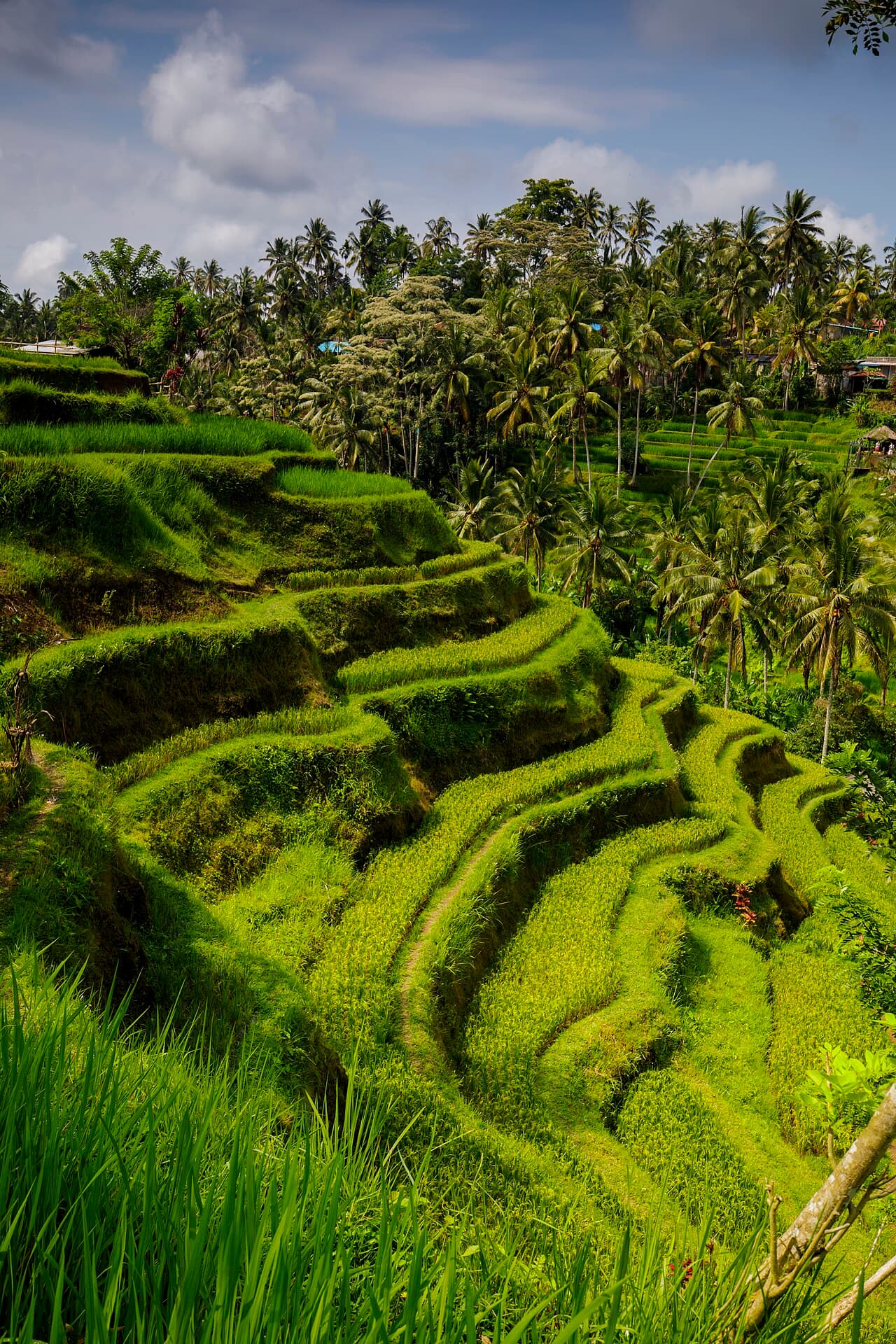
- Rice terrace photography. Tegalalang, Jatiluwih, and the Sidemen terraces glow electric green in wet season. Dry-season photos look brown by comparison.
- Manta ray diving at Nusa Penida. The peak sighting season is November–April — i.e. wet season. Visibility is slightly lower but the encounters are more frequent.
- East-coast surf. Keramas, Sanur, and Nusa Dua come alive when the wind switches direction in November.
The Real Advantages of Visiting in Wet Season
Prices Drop 20–35 %
This is the biggest draw. Accommodation rates fall meaningfully:
| Accommodation Type | Dry Season | Rainy Season | Savings |
|---|---|---|---|
| Budget guesthouse | $25–40/night | $18–28/night | 25–30 % |
| Mid-range hotel | $60–120/night | $45–85/night | 25–30 % |
| Luxury villa | $200–400/night | $130–270/night | 30–35 % |
Activities, spa treatments, and even some restaurants drop prices to fill the gap. Tour operators (us included) sometimes offer wet-season packages that bundle a private driver with a cooking class and a spa.
The exception: Christmas through January 5 is the one wet-season price spike. Avoid it if you are budget-driven.
Fewer Crowds
If you have seen photos of packed temple courtyards and shoulder-to-shoulder rice terraces, that is dry season and holidays. During January and February, popular spots feel remarkably empty. Tirta Empul on a Tuesday morning in February has maybe 30 visitors. The same temple in August has 800.
This makes for a more authentic experience. You can speak with temple attendants, take photos without 50 people in frame, and feel the spiritual atmosphere of sacred sites. We have had Tegalalang almost to ourselves at 8 AM in February.
Greener Landscapes
Bali in wet season is almost impossibly green. Rice paddies glow, jungle foliage thickens, rivers and waterfalls are full. If photography is part of your trip, this is the most dramatic season.
Common Wet-Season Mistakes Travellers Make
After many seasons of guests, the same five mistakes show up again and again. Avoid them:
- Booking a 4 PM Uluwatu sunset in January. It will rain. The Kecak fire dance still happens, but the cliff view often disappears in cloud. Switch to a 4 PM Tanah Lot in March instead — it sits in a slightly drier coastal pocket.
- Renting a scooter as a beginner. Wet pavement, oily storm runoff, and standing water make February the worst month to learn. Use a private driver for the trip and rent for short Canggu loops only.
- Underestimating Ubud's microclimate. Ubud rains more often (and earlier in the day) than Sanur. If you want sun, schedule Ubud days around morning trips and afternoon spas; do not put a 3 PM rice-terrace walk in the plan.
- Skipping waterfalls because of rain. This is backwards. Wet season is the BEST time to see them. Sekumpul, Aling-Aling, and Nungnung are at their most powerful November to March.
- Booking a Mt. Batur sunrise trek without a buffer day. January and February have a real chance the trek is cancelled or the summit is fogged in. Either skip it, or build in a second-attempt day.
What to Pack for Bali's Rainy Season
- Lightweight rain jacket (not a heavy one — humidity makes it unbearable). A packable shell is ideal.
- Quick-dry clothing. Cotton stays wet for hours. Synthetic or merino dries in 30 minutes.
- Waterproof sandals or quick-dry shoes. Flip-flops on wet Bali pavement is how people fall.
- Dry bag or waterproof phone pouch. $10–15 on Amazon. Worth it.
- Insect repellent with DEET. Standing water increases mosquitoes. Dengue risk is slightly elevated.
- Small umbrella. For walking between scooter and restaurant.
- Power bank. Brief power flickers happen during storms.
You do not need to overpack — minimarts sell ponchos, umbrellas, and basic clothing everywhere.
Who Should (and Shouldn't) Visit During Rainy Season
Great For
- Budget travellers — wet season is the best value of the year
- Couples wanting a romantic, quiet Bali
- Surfers targeting east-coast swells
- Photographers after dramatic landscapes and full waterfalls
- Wellness, spa, and yoga-focused trips
- Long-stay digital nomads stretching their budget
- Divers heading to Nusa Penida (manta peak season)
Think Twice If
- You only have 3–4 days and need guaranteed sunshine
- Beach-lounging from morning to night is your primary plan
- You get frustrated by disrupted schedules
- You have mobility issues — wet surfaces and flooded paths are real
If your trip falls in January or February and beach time matters, base yourself in Sanur or Nusa Dua (sheltered east coast — both consistently get 15–20 % less rain than Canggu or Seminyak).
FAQ
Should I avoid Bali from November to March?
No. Wet season has real advantages — lower prices, fewer crowds, and the most dramatic landscapes of the year. The one period to actually avoid for most travellers is December 22 to January 5, when prices spike for the Christmas/New Year peak without any improvement in weather. If you only have 3–4 days and need guaranteed sunshine, then yes, lean toward May–September instead.
Are flights to Bali cheaper during rainy season?
Yes, modestly. Flights to Denpasar (DPS) are typically 10–20 % cheaper from late January through early March compared to July or August. The exception is Christmas/New Year and Chinese New Year — both sit inside wet season but are price spikes. Hotels save you much more than flights.
Will the roads flood?
Some streets, briefly. Low-lying areas in Canggu, Kuta, and parts of Denpasar can have 20–30 cm of standing water for 30–60 minutes after a heavy storm. Main highways (Bypass Ngurah Rai, the Ubud road) drain quickly. We rarely cancel a transfer for flooding — we just route around it. If you are renting a scooter, do not ride through flooded streets; walk it.
Can I surf during Bali's rainy season?
Yes — and the east coast is at its best. The seasonal wind switch in November makes Keramas, Sanur, and Nusa Dua work consistently. Uluwatu and Padang Padang (west coast) become inconsistent, with onshore wind and choppier conditions. Morning sessions before 10 AM are most reliable across the whole island.
Are hotels really cheaper during wet season?
Yes — typically 20–35 % cheaper than peak August rates. Luxury villas drop the most in absolute dollars. The exception is Christmas/New Year week, which costs more than dry-season July. Book directly with smaller properties (or via WhatsApp) for the best wet-season deals — they rarely match their lowest rates on Booking.com.
What should I pack for Bali's rainy season?
A light rain jacket, quick-dry clothing, waterproof sandals, a dry bag or waterproof phone case, DEET insect repellent, and a small umbrella. Skip the heavy rain gear — humidity makes it miserable. Most other supplies are available at Bali's minimarts for next to nothing.
Is "monsoon" the same as "rainy season" in Bali?
Practically yes — Bali's "rainy season" is technically the northwest monsoon (musim hujan), driven by winds blowing from Asia across the Java Sea. Locals just say "wet season" or "musim hujan." There is no separate monsoon event like the Indian subcontinent's. The terms refer to the same November–March period.
Is rainy season dangerous?
Not inherently. The main weather-related risks are temporary road flooding (drive carefully or use a driver who knows the routes), slippery surfaces, and increased mosquito activity. Cyclones do not affect Bali — the island sits south of the typhoon belt. For the full safety picture see our guide on whether Bali is safe.
When exactly does Bali's rainy season start and end?
The wet season typically starts in early November and ends in late March, with December, January, and February being the wettest months. November and March are shoulder months — genuinely mixed, with long sunny stretches between storms. The very first week of April often feels like full dry season.
If you are planning a wet-season trip and want an itinerary built around the timing playbook above, reach out via WhatsApp — we will design a day-by-day plan that front-loads outdoor activities and slots indoor backups for the afternoon storm window.
Sources & Verification
All rainfall, temperature, and humidity figures on this page are 30-year averages from official Indonesian meteorology data, cross-checked against our own year-round on-the-ground observations.
- BMKG (Badan Meteorologi, Klimatologi, dan Geofisika): bmkg.go.id — Indonesia's national meteorology agency. Source for monthly rainfall averages, temperature, humidity, and ENSO/La Niña / El Niño long-range forecasts.
- BMKG South Bali station data: monthly precipitation reports for Denpasar, Sanur, Kuta.
- BMKG North Bali station data: highland figures for Munduk, Bedugul, Kintamani.
- Internal Ohana on-the-ground records: daily weather notes from guided trips November 2024 – April 2026, used to validate the "afternoon storm window" pattern and per-month qualitative descriptions.
- Last verified: 2026-05-01.
Related Guides
<!-- internal-link-sweep:2026-04-29 -->
Certified Travel Guide & Co-Founder
A certified Bali guide credentialed by the Indonesian Ministry of Tourism, fluent in French, Mandarin, English, and Indonesian. Part of a family of certified guides who have been guiding travelers across Bali for many years — sharing temples, rice terraces, and hidden corners that never make the brochures.
Languages: French · Mandarin · English · Indonesian
Ready to discover Bali?
Tell us about your dream trip and our local experts will craft a personalized experience just for you.
Start Planning