Quick answer: Lovina is a 10 km stretch of black volcanic sand beach on Bali's north coast, about 3 hours by car from the airport. It is best known for dawn dolphin watching trips, calm reef-protected swimming, the sulfurous Air Panas Banjar hot springs, and the Brahma Vihara Arama Buddhist monastery 30 minutes inland. Snorkeling close to shore is excellent for beginners and families. Lovina has no resorts and no nightlife — accommodation is mid-range guesthouses and small boutique hotels. Best visited April to October during the dry season. Stay 2 to 3 nights as part of a north Bali loop with Munduk or Sekumpul. Quieter, older, and more low-key than south Bali.
Lovina is the part of north Bali that most first-time visitors never see, and that's exactly why we keep recommending it to the right kind of traveler. Our family of certified guides — Indonesian, originally from Medan and living in Bali for years — has been bringing visitors over the central mountains to this stretch of black sand for a long time, and the answer to "is Lovina worth it?" is almost always the same: yes, if you understand what it is. Lovina is not a beach holiday in the southern Bali sense. There are no infinity pools over the surf, no beach clubs, no five-star resort strip. What you get instead is a long, quiet, calm-water shoreline of black volcanic sand, a small dolphin-watching tradition, sulfurous jungle hot springs, the largest Buddhist monastery in Bali, a reef close enough to swim to, and a slower, older, more local rhythm. It is the right base for travelers who want to see north Bali without rushing — older couples, backpackers on a longer route, families with snorkel-curious kids, and anyone tired of the south coast crowds.
Lovina's black-sand beaches
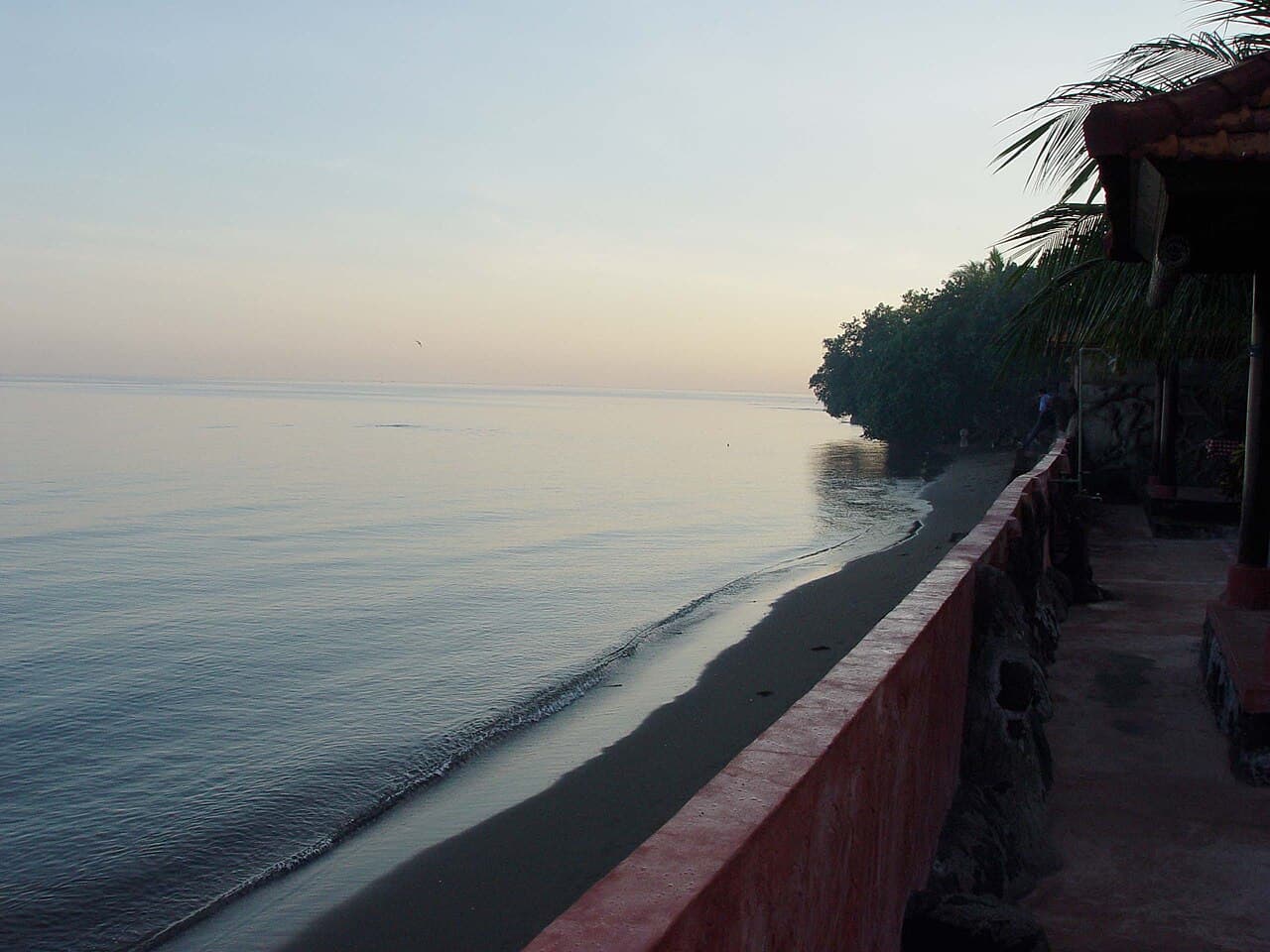
The first thing visitors notice in Lovina is the sand: it is genuinely black. This is volcanic sand, ground down over millennia from the basalt of Bali's north-coast lava flows and the cones of Mount Agung and Mount Batur further inland. The colour ranges from charcoal grey when wet to a deep mineral black when dry, and on overcast mornings the beach has a slightly otherworldly look. The sand absorbs heat, so it gets very hot underfoot in the middle of the day — bring sandals.
The Lovina shoreline runs roughly 10 kilometers from the eastern edge of Pemaron through Tukad Mungga, Anturan, Banyualit, Kalibukbuk, and out west to Temukus. It is not one continuous beach but a series of bays separated by small headlands, fishing villages, and river mouths. Most of the hotels and the main tourist center cluster around Kalibukbuk, where you'll find the famous dolphin statue at the end of Jalan Binaria.
Swimming — The bay is reef-protected, so the water is genuinely calm most of the year. There is no surf in the south Bali sense. At low tide the sea pulls back to reveal patches of dark rock and coral fragments — reef shoes are useful. At high tide you can swim straight off the sand. Water temperature stays between 27 and 30°C / 81 and 86°F year-round.
Local atmosphere — These are working beaches. Outrigger fishing boats (jukung) line the sand, painted in bright blue, red, and yellow. Fishermen go out at first light, return mid-morning, and pull their boats up before the heat. In the afternoons children play football on the sand and the boats become diving platforms for local kids. There are far fewer beach vendors than in the south, and the ones who come around tend to leave quickly when you say no.
Sunsets — Because Lovina faces north, you don't get a classic over-the-water sunset, but the light on the Java Sea in the late afternoon is soft and golden, and the fishing boats heading out for the night make a beautiful foreground.
Dawn dolphin watching — what it really is
Lovina's signature activity is dawn dolphin watching, and it deserves an honest discussion. Wild spinner dolphins and bottlenose dolphins do live in the Bali Sea off Lovina, and they do feed close to shore in the early mornings. A trip out at first light to see them in their natural habitat is, on a good day, magical. But the activity has a complicated reputation, and visitors should know what they're booking.
The good — These are wild dolphins, not captive ones. The boats are small, locally built outriggers operated by Lovina fishermen, and the income from dolphin trips supplements their fishing. On a quiet morning with the right operator you can drift with the engine off and watch a pod cruise past at close range, with the volcano of Java visible across the strait.
The bad — On peak-season mornings dozens of boats race out together and chase the same small pod, surrounding the dolphins and forcing them to dive. The animals are clearly stressed, and the experience for the visitor is often more about boat-jockey behaviour than wildlife. Some operators run the engine right alongside the pod or cut in front of the dolphins to give the camera shot. We do not recommend that kind of trip.
How to do it well — Book through your guesthouse the evening before, ask explicitly for a small operator, and ask three questions: will the engine be turned off when dolphins are near, will the boat keep distance, and will the captain refuse to chase? Good operators say yes without hesitation. Boats leave around 5:30 to 6:00 a.m. so you'll need an early alarm. The trip lasts 1.5 to 2 hours and costs roughly 100,000 to 200,000 IDR (US$7 to 13) per person — slightly more if booked through a hotel.
When to go — The dry season (April to October) has calmer seas and clearer mornings. Off-peak months — April, May, and October — have far fewer boats out, which is better for the dolphins and for you. Going on a Tuesday or Wednesday rather than a weekend also helps.
Realistic expectations — Sightings are common but not guaranteed. On a good morning you'll see one or two pods at a few hundred meters, sometimes leaping or feeding. On a bad morning you'll see distant fins or nothing at all. If ethical wildlife viewing matters more to you than the certainty of a sighting, consider skipping the dolphin trip entirely and going snorkeling or visiting the monastery instead.
Air Panas Banjar — the hot springs
About 20 minutes' drive west of Kalibukbuk, tucked into a jungle ravine behind the village of Banjar, are the Air Panas Banjar hot springs — one of the most distinctive and atmospheric thermal baths in Bali. The water is naturally heated, lightly sulfurous, and channelled through carved stone dragon-head spouts into three terraced pools shaded by enormous trees and tropical foliage.
The springs sit on the grounds of a small Buddhist temple, and the architecture reflects that — carved stone pavilions, mossy steps, small offerings tucked into corners. The main pool is bathwater-warm, around 37°C / 99°F, and the second pool is hotter. The third pool sits below a row of three dragon spouts that pour heated water onto your shoulders from about 2 meters up — visitors line up under them for the best free shoulder massage in north Bali.
Practicalities — Open daily from around 8 a.m. to 6 p.m. Entry is roughly 30,000 IDR (US$2) for adults and less for children. Bring a swimsuit (modest is appropriate — this is a Buddhist site), a towel, and flip-flops. There are simple changing rooms and a small restaurant on site. Mid-morning is typically the quietest. Try to avoid Sundays when local families come.
Pairing — Most visitors combine the hot springs with the Brahma Vihara Arama monastery, which is only a 5-minute drive further uphill. A morning at the monastery followed by lunch and a soak in the springs is a classic north Bali half-day.
Brahma Vihara Arama — Bali's largest Buddhist monastery
About 30 minutes south of Lovina, perched on a hillside above the village of Banjar, is Brahma Vihara Arama — the largest Buddhist monastery in Bali and one of the most peaceful religious sites on the island. Built in 1970 in a Buddhist-Balinese fusion style, it has the layered courtyards and split gates of a Hindu temple but with stupas, a meditation pavilion, and a small replica of Borobudur.
Bali is overwhelmingly Hindu, but pockets of Buddhism, Christianity, and Islam exist around the island, and Brahma Vihara is the spiritual heart of the Balinese-Indonesian Buddhist community. Monks live on site, and visitors are welcome to walk the grounds quietly, sit in the meditation gardens, and admire the views over the rice fields and out toward the Java Sea.
Practicalities — Open daily from 8 a.m. to 6 p.m. Donation entry (a few thousand rupiah). Sarongs are required and provided at the entrance. Modest dress is expected. The site is large but easy to walk in 45 minutes to an hour. There is no commercial activity inside, no vendors, and very few crowds. Photography is permitted; flash is not.
Why visit — Even if you are not Buddhist, this is a genuinely peaceful site with a quietly unusual architecture for Bali. The combination of Brahma Vihara plus the Banjar hot springs is one of the more memorable half-days you can plan from Lovina, and many of our guests rank it above the dolphin trip.
Snorkeling and diving
Lovina's reef sits unusually close to shore — in some places only 30 to 50 meters out — which makes the area one of the more accessible snorkeling spots in Bali. The bay is reef-protected, the water is generally calm, and visibility in the dry season is good. The coral is patchy but alive, and the reef supports the usual cast of clownfish, parrotfish, butterfly fish, sergeant majors, and the occasional small reef shark or moray eel.
Snorkel trips — Most boat operators run a 2-hour combo trip that includes a dolphin viewing followed by a snorkel stop, but you can also book a snorkel-only trip that leaves later in the morning. Expect to pay 200,000 to 400,000 IDR (US$13 to 27) per person including mask, snorkel, fins, and the boat. The boat takes you 5 to 10 minutes offshore, anchors at a sandy patch near the reef, and gives you 60 to 90 minutes in the water.
Diving — Lovina has a few small dive operators running shore dives and shallow boat dives suitable for beginners and refresher courses. Sites are generally easy, with little current and depths of 5 to 18 meters. Expect 700,000 to 1,200,000 IDR (US$45 to 80) for a two-tank dive day. For more dramatic diving — wall dives, big fish, drift conditions — most experienced divers continue west to Pemuteran and Menjangan Island, about an hour from Lovina.
Family snorkeling — The shallow nearshore reef makes Lovina one of the better introductions to snorkeling for children. Several hotels rent masks and fins for use directly off their stretch of beach.
Day trips from Lovina
Lovina's location makes it a good base for the entire northern half of Bali. The drive times below are approximate and best handled with a private driver.
Munduk and the twin lakes (1 hour south) — Highland village with waterfalls, coffee plantations, and Lake Tamblingan. A full-day trip from Lovina is feasible but tight; many guests prefer to combine 2 nights in Lovina with 1 to 2 nights in Munduk.
Sekumpul Waterfall (1.5 hours) — Often called Bali's most beautiful waterfall, a multi-tier curtain of water in the jungle south of Singaraja. The trek down and back up is genuinely demanding (steep stairs, possibly slippery). Read our best Bali waterfalls guide for Sekumpul distances, fees, and what to bring.
Banyumala Twin Waterfalls (1 hour) — Less famous than Sekumpul but easier to reach and just as photogenic, with a swimmable plunge pool. Often combined with a Munduk loop.
Ulun Danu Beratan Temple (1.5 hours) — The lake temple at Bedugul, one of the most photographed sites in Bali. Best visited on the way to or from the south coast.
Pemuteran and Menjangan Island (1 hour west) — Pemuteran has Bali's most successful coral reef restoration project (the Biorock program) and a quieter, drier coastline. Menjangan Island, accessed by boat from Pemuteran, has the best visibility in north Bali and dramatic wall dives. Pemuteran also has a small but interesting dive scene.
Jatiluwih UNESCO Rice Terraces (1.5 hours) — Less crowded than Tegallalang, vast and beautifully maintained.
Singaraja old port (15 minutes east) — The old colonial Dutch warehouses, the Chinese temple, and the historic harbor are worth a 1- to 2-hour wander. Singaraja was Bali's capital under Dutch rule and was the main port of entry to the island until the 1970s. Most visitors don't go, which is the appeal.
East to Amed (3 hours) — Long but doable with an early start. See our Amed destination page for what to do once you arrive.
All of these day trips are easiest with a private driver — public transport in north Bali is limited and renting a scooter for these distances on unfamiliar mountain roads is not something we recommend for first-time visitors.
Where to stay in Lovina
Lovina has no resorts in the south Bali sense — no infinity pools cantilevered over the sea, no five-star high-rises, no hotel brands. What it has instead is a mix of family-run guesthouses, mid-range boutique hotels in tropical gardens, and a handful of older, larger hotels that have been operating for decades. The lack of big-brand accommodation is deliberate: north Bali zoning rules and the local economy have kept resort development off the coast, and most visitors who come here actively prefer it.
Kalibukbuk (the main center) — Around Jalan Binaria and the dolphin statue. Best for first-time visitors. Walking distance to most restaurants, dive shops, dolphin operators, and small bars. The most variety of accommodation. Some traffic noise on the main road, so ask for a back-garden room.
Anturan and Banyualit (just east of Kalibukbuk) — Quieter, smaller villages with fewer restaurants but more authentic atmosphere and quieter beaches. Better for travelers who want to relax and don't mind walking 10 minutes or taking a short scooter ride to reach the main strip.
Temukus and Pemuteran direction (west) — Quietest end of Lovina. Some of the better mid-range boutique hotels are here, in larger gardens directly on the beach. Furthest from restaurants.
Budget (200,000 to 500,000 IDR / US$13 to 33 per night) — Family-run guesthouses with simple but clean fan or air-conditioned rooms, breakfast included, often with a small garden. Excellent value.
Mid-range (600,000 to 1,500,000 IDR / US$40 to 100 per night) — This is where Lovina shines. Boutique hotels with real character — open-air bathrooms, tropical gardens, freshwater pools, beachfront access. The quality-to-price ratio is much better than the equivalent in Seminyak.
Higher-end (1,800,000 IDR+ / US$120+) — A handful of older established hotels and a few newer boutique villas. Comfortable but not luxury in the south Bali sense.
A practical tip: many of the better mid-range hotels are not directly on the main road, which is good for noise but means you'll want to arrive with a driver rather than wander on foot. If you book a custom itinerary with us, we'll match you to a property that fits the type of trip you want.
How many days in Lovina
Two to three nights is the standard recommendation, and it works for most travelers.
Two nights — One day for the beach, dolphin watching at dawn, and Banjar hot springs. One day for Brahma Vihara, snorkeling, and an afternoon on the sand. This is enough to feel rested and to see the headline attractions.
Three nights — Add a Sekumpul or Banyumala waterfall day trip, or a full day at Pemuteran and Menjangan for snorkeling. Three nights also works well if you arrived after a long flight and want a buffer day.
Four nights or more — Only if you genuinely want to slow down, swim every morning, and let the days run together. Lovina rewards this kind of trip — but if you're on a 10- to 14-day Bali itinerary, four nights here is usually too many.
For first-time visitors building a north Bali loop, the most popular pattern is: 1 to 2 nights in Munduk for waterfalls and lakes, then 2 nights in Lovina for the beach and dolphins, then onward to Amed or back to the south. See our Bali 7-day itinerary for full multi-stop routes.
How to get to Lovina
Lovina is roughly 100 kilometers north of Ngurah Rai International Airport — about a 3-hour drive crossing the central mountains. There is no airport on the north coast, so every visitor arrives by road.
Private driver from the south (recommended) — The most comfortable and most flexible option. About 3 hours from the airport, Seminyak, or Canggu, and 2 to 2.5 hours from Ubud. The drive itself is one of the most scenic on Bali, climbing through Bedugul and the lakes region before descending the volcanic ridge to the north coast. Most drivers will happily build in stops at Ulun Danu Beratan Temple, Munduk, or Banyumala Waterfalls, turning the transfer into a half-day sightseeing trip. Expect 700,000 to 1,200,000 IDR (US$45 to 80) for the one-way ride.
Shared shuttle (Perama and similar) — Cheaper but less flexible. Departs once or twice daily from Kuta, Ubud, and Sanur. Around 200,000 IDR per person. Slow with luggage and small children.
Self-drive scooter — Possible but only for experienced riders. The mountain road is winding, narrow in places, and has heavy truck traffic on the main routes. Not recommended for visitors unfamiliar with Indonesian traffic.
Public bus — Possible (Mengwi terminal to Singaraja, then short ride to Lovina) but slow and not luggage-friendly. We don't recommend it for first-time visitors.
For the mountain-pass photo stops and lunch breaks combined into a north-Bali loop, see our Munduk destination guide and the best Bali waterfalls guide — both cover the drive in practical detail.
Lovina vs Amed vs Pemuteran
These three are Bali's main alternatives to the southern beach resorts. They share calmer water, less crowding, and an emphasis on snorkeling and slow travel — but they differ in important ways.
| Feature | Lovina | Amed | Pemuteran |
|---|---|---|---|
| Coast | North | East | Northwest |
| Coast direction | Faces north (Java Sea) | Faces east (sunrise over Lombok) | Faces north (Java Sea) |
| Beach color | Black volcanic sand | Black volcanic sand | Black volcanic sand |
| Vibe | Quiet, older, fishing village | Diving-focused, slow, scenic | Quietest, eco-focused |
| Headline activity | Dawn dolphin watching | Wreck and reef diving | Coral restoration, Menjangan diving |
| Snorkeling close to shore | Excellent (reef close in) | Excellent (USS Liberty wreck and reefs) | Good (Biorock + Menjangan boat) |
| Distance from south | ~3 hours by car | ~3 hours by car | ~4 hours by car |
| Hotel scene | Mid-range guesthouses | Small dive resorts | Boutique eco-hotels |
| Best for | Families, older travelers, dolphin curious | Divers, snorkelers, photographers | Reef enthusiasts, quiet trips |
Most experienced travelers we work with end up choosing two of the three for a longer trip. Lovina + Pemuteran is the easiest combination because they're an hour apart on the same coast. Lovina + Amed requires a 3-hour drive across the north and east but adds the dramatic east-coast diving.
Lovina vs South Bali
For first-time visitors deciding whether Lovina deserves space in their itinerary, this is the cleanest way to think about the contrast.
| Feature | Lovina (north) | South Bali (Seminyak, Canggu, Sanur) |
|---|---|---|
| Beach | Calm, black sand, reef-protected | Big swell, white/grey sand, surf |
| Vibe | Quiet, older, slow | Trendy, varied, busy |
| Crowds | Light to moderate | Heavy |
| Nightlife | Almost none | Major scene (Seminyak, Canggu) |
| Dining | Local warungs and small restaurants | International, fine dining, beach clubs |
| Hotels | Mid-range guesthouses, boutique | Full range up to 5-star |
| Snorkeling from the beach | Yes, reef close in | Almost none |
| Best for | Slow travel, nature, families | Variety, dining, surf |
Lovina is a complement to south Bali, not a replacement. The most satisfying first-time itineraries we plan combine 4 to 5 nights in the south or in Ubud, 1 to 2 nights in Munduk, and 2 nights in Lovina, sometimes ending with Amed or the Nusa islands. Lovina by itself is too quiet for most travelers; paired with a livelier base it gives a balance that is hard to get any other way.
Practical tips
Best time to visit — April to October. The dry season has calmer seas, better dolphin and snorkeling conditions, and clearer skies for the mountain crossing. November to March is fine for a short stay, but heavy afternoon rain can disrupt boat trips and the mountain road can be slick. See our best time to visit Bali guide for a month-by-month breakdown.
Getting around Lovina — Most things in Kalibukbuk are walkable. For longer trips along the coast, hire a scooter (50,000 to 80,000 IDR per day) or a driver. Ride-hailing apps work but with fewer drivers than in the south. For day trips into the mountains, always take a private driver.
ATMs and money — ATMs are common along the main road in Kalibukbuk. Use ones attached to bank branches (BCA, Mandiri, BNI) to avoid skimmers. Bring some cash for warungs, the hot springs, and small operators.
Wi-Fi and remote work — Reliable in most hotels and cafes. Lovina is not a coworking destination like Canggu, but for a few days of email and video calls it works fine.
Safety — Lovina is one of the safer parts of Bali. Petty theft from beach loungers happens occasionally; don't leave phones unattended. The biggest practical risk is scooter accidents on the coast road — drive slowly and watch for trucks and dogs.
Cultural notes — North Bali is distinctly different from the south — the dialect of Balinese is different, the temple architecture is more flamboyant, and there is a small but visible Buddhist and Chinese-Indonesian population in Singaraja. Be respectful at temples, the hot springs (which are on Buddhist monastery grounds), and ceremonies. Cover shoulders and knees.
Currency — Indonesian rupiah (IDR). At April 2026 rates, US$1 is roughly 16,000 IDR.
Mosquitoes — More noticeable than in the breezy south. Bring repellent, especially for evenings.
Lovina will not be the highlight of every Bali trip, and that is part of why we like sending the right travelers here. It is what the south coast was 30 years ago — a working fishing coast with a small tourist overlay rather than a tourist coast with a few fishermen. For visitors who want to see north Bali, who care about quiet, and who want a beach that isn't trying to be anything else, this is the easiest base on the island.
Frequently Asked Questions
Where is Lovina in Bali?
Lovina is on Bali's north coast, about 10 kilometers west of Singaraja, the island's former capital. It is roughly 3 hours by car from Ngurah Rai International Airport in the south, crossing the central mountains via Bedugul. Lovina is not a single village but a 10 km stretch of black-sand beach covering six small villages — Pemaron, Tukad Mungga, Anturan, Banyualit, Kalibukbuk, and Temukus. Kalibukbuk is the main tourist center.
Is dolphin watching in Lovina ethical?
It is mixed. Wild dolphins do swim in the Bali Sea every morning, and seeing them in their natural habitat is a real experience. The problem is that on busy days dozens of boats chase the same pod, which is stressful for the animals. We recommend going with a small local operator who agrees to keep distance, switch off the engine when dolphins are near, and refuse to chase. Going outside peak season (April, May, October) and arriving on a quieter day is also better. If ethical wildlife viewing matters to you, consider snorkeling or a Brahma Vihara visit instead — both are excellent.
Is snorkeling in Lovina worth it?
Yes, especially if you are traveling with children or are a beginner. The reef sits very close to the shore, the bay is reef-protected and calm, and visibility is generally good in the dry season. The coral is not as dramatic as Menjangan or Amed, but you will see clownfish, parrotfish, butterfly fish, and small reef sharks. Most hotels can arrange a 2-hour boat trip for around 200,000 to 400,000 IDR per person including mask, snorkel, and fins.
How many days should I spend in Lovina?
Two to three nights is the sweet spot. One day for the beach, dolphin watching at dawn, and the hot springs. A second day for snorkeling or a Brahma Vihara visit. A third day if you want to add the Sekumpul or Munduk waterfalls as a long day trip. Lovina is a base for north Bali, not a destination you spend a week in.
How do I get to Lovina from the airport?
The most reliable option is a private driver — about 3 hours from Ngurah Rai International Airport, crossing the mountains via Bedugul and Munduk. The drive itself is scenic and you can stop at Ulun Danu Beratan Temple, Banyumala twin waterfalls, or Munduk on the way. Public buses (Perama) also connect Denpasar to Lovina but are slow and inconvenient with luggage. We recommend our private driver service so you can break the drive with a few stops and arrive relaxed.
Is Lovina quieter than south Bali?
Much quieter. Lovina has no big resorts, no beach clubs, no nightlife strip. The main road through Kalibukbuk has small restaurants, a few bars, and quiet guesthouses set in gardens. Traffic is a fraction of Seminyak or Canggu. The pace is slower, the demographic is older and more international, and most visitors come for nature and quiet rather than parties or shopping. If that sounds appealing, we can build a custom itinerary that pairs Lovina with the right second base.