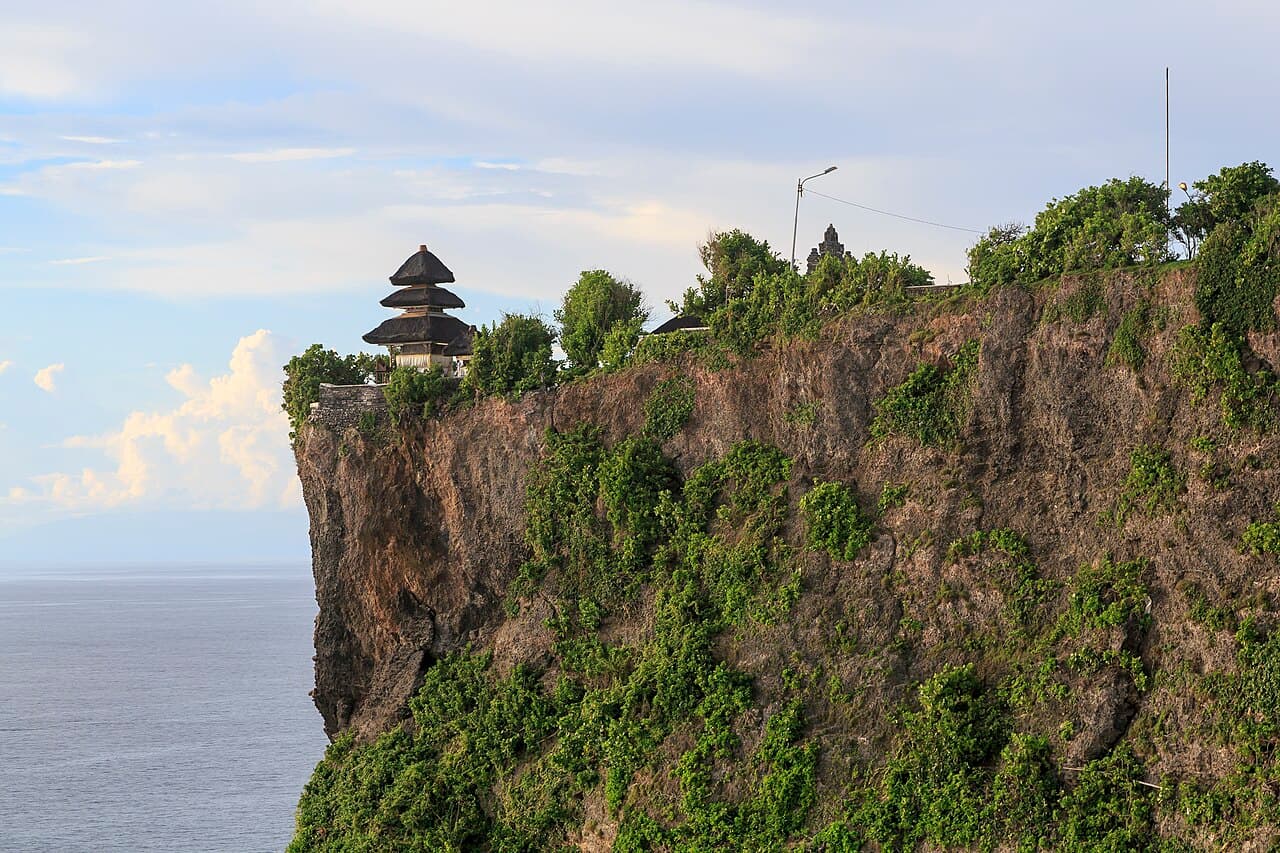
Quick answer: The Bukit Peninsula is the elevated limestone plateau forming the entire southern tip of Bali, south of Ngurah Rai International Airport. It covers the cliff-top temple zone of Uluwatu, the surf coves of Padang Padang, Bingin, and Balangan, the seafood-grill bay of Jimbaran, the gated luxury enclave of Nusa Dua, and the residential mid-Bukit area of Pecatu (home to GWK Cultural Park). Most travelers stay 3 to 5 nights to cover the temple, two or three beaches, surf or beach-club days, and a Jimbaran sunset dinner. Best visited April to October for dry weather and the strongest swells.
The Bukit Peninsula is the part of Bali that does not look or feel like the rest of Bali. North of the airport, the island is volcanic — black sand, rice terraces, jungle ridges. South of the airport the geology changes completely: a raised limestone plateau drops to the sea in 70-meter cliffs, and the rivers, rice fields, and dense forest disappear. "Bukit" simply means "hill" in Indonesian, and locals have used that name for the plateau for centuries. What used to be a remote, hard-to-reach corner reserved for surfers and pilgrims is now the most concentrated stretch of cliff-edge resorts, world-class waves, and white-sand coves on the island. It is also where the most photographed Bali clichés — the clifftop temple at sunset, the seafood plate on the sand, the limestone-cave beach — actually happen.
The peninsula is small enough to cover with a private driver or a confident scooter rider, but spread out enough that where you stay defines what your trip feels like. A traveler based in Nusa Dua experiences a calm, manicured resort holiday. A traveler based in Bingin lives on dawn surf checks and sunset chai by a bonfire. The same beach is 20 minutes apart, but the two trips would barely overlap. This guide covers each sub-area, the surf breaks and beaches, the cultural sights, and how to choose your base — so you can plan a Bukit stay that matches what you actually came for.
What is the Bukit Peninsula?
The Bukit (sometimes written "Bukit Badung" or just "Bukit") is the entire landmass south of the airport runway. Geographically it is connected to the rest of Bali by a narrow neck of land where the airport and Tuban sit; everything south of that is the peninsula. The plateau averages around 200 meters above sea level, with the cliffs at the southern and western edges plunging directly into the Indian Ocean. There are no rivers, very little surface water, and historically very little agriculture — which is why the area was sparsely populated until tourism arrived. Today it is administratively part of Badung Regency, but tourists treat it as its own region.
The Bukit covers six functional sub-areas. Each has a distinct character, and many travelers who think they are choosing "Uluwatu" are really choosing Pecatu, Ungasan, or Bingin — different villages a few kilometers apart with different vibes and very different price points.
| Sub-area | Character | Beaches | Best for |
|---|---|---|---|
| Uluwatu (cliff edge) | Cliff temple, sunset, dramatic views | Suluban, Thomas, Padang Padang | Sunset chasers, photographers, couples |
| Padang Padang + Bingin | Surf-and-chill villages above the breaks | Padang Padang, Bingin, Impossibles | Surfers, budget and mid-range travelers |
| Balangan | White sand, calmer surf, fewer crowds | Balangan Beach | Day-trippers, intermediate surfers |
| Jimbaran | North bay, sheltered, sunset seafood | Jimbaran Bay (4 km crescent) | First-night, last-night, families, honeymoons |
| Nusa Dua | Gated luxury resort enclave | Nusa Dua, Geger Beach | Families, all-inclusive holidays, golf |
| Pecatu (mid-Bukit) | Residential, GWK, Dreamland | Dreamland | Mid-range villas, road trippers |
Distances are short on the map but slow on the road — narrow lanes, sharp climbs, and weekend traffic can stretch a 12-kilometer trip to 45 minutes. Most travelers cover the peninsula with a private driver for at least a day or two; scooters work for confident riders staying within one sub-area.
Uluwatu — Cliffs, Temples, and Sunset
The cliff-edge zone at the southwestern tip of the peninsula is the most photographed stretch of Bali. This is where Pura Luhur Uluwatu — the 11th-century clifftop sea temple — stands on a limestone cliff 70 meters above the surf, framed by a panorama of the Indian Ocean. The temple is one of Bali's six "kayangan jagat" directional temples, dedicated to protecting the island from negative forces from the sea, and is genuinely sacred. Most visitors come for the daily Kecak fire dance: a chanted, choreographed performance held in an open-air amphitheater on the cliff edge, beginning around 6:00 pm and timed to climax with the sunset.
Below the cliffs, the same stretch of coastline holds Uluwatu's hidden beaches — Suluban (also called Blue Point), Thomas Beach, Padang Padang — accessed by stair descents through the limestone. Above the beaches, the cliff road is lined with beach clubs (Single Fin, Sundays, Ulu Cliffhouse) that have made Uluwatu sunset into its own kind of nightlife. For a deeper breakdown of what to do here including the Kecak timing, beach access, and clifftop dining, read our dedicated Uluwatu destination guide and the things to do in Uluwatu listicle.
Padang Padang and Bingin — Surf Villages
Drive 10 minutes north of Uluwatu and the cliff-edge resort scene gives way to a different world: the surf villages of Padang Padang and Bingin. These are still working surf communities, where bungalows above the cliff cost a fraction of a beach club cocktail down the road, and the rhythm of the day follows the swell rather than the sunset hashtag.
Padang Padang Beach sits in a narrow cleft between cliffs, accessed by a stairway cut through a limestone cave. The beach itself is a small cove — perhaps 100 meters long at low tide, almost nothing at high — with a famous left-hand reef break ("Padang Padang") working in front of it on bigger swells. The village above is more developed than Bingin, with cafes, surf shops, scooter rentals, and a Padang Padang Café that has become a sunset standard.
Bingin Beach is harder to reach and that is most of its appeal. From the clifftop parking, a steep concrete stairway descends through a hamlet of bungalows clinging to the rock face. The beach reveals itself only at low tide as a flat white-sand reef shelf in front of a fast, hollow left-hander. Mid-tide the wave breaks over barely-covered reef; high tide the beach disappears entirely. Surfers and photographers who plan around the tide get one of the most beautiful coves in Bali; visitors who arrive at high tide wonder what the fuss is about.
The accommodation here is mostly mid-range and budget: surf bungalows from 600,000 to 1.5 million IDR per night, simple homestays under that. Food is excellent — small warungs and surf cafes serving banana smoothie bowls in the morning and grilled fish at night. This is where to stay if you want to live a surf-village rhythm without committing to a Six Senses budget.
Balangan — White Sand and Calmer Surf
Balangan is the easygoing middle ground of the Bukit. The beach is a 1-kilometer crescent of fine white sand backed by limestone cliffs, with a left-hand reef break (Balangan) further out and softer reform waves on the inside. It is one of the most photogenic beaches on the peninsula — wider and flatter than Bingin, less developed than Dreamland, and rarely as crowded as Padang Padang.
The vibe is relaxed: a row of beach warungs with sun loungers, a few small bungalows on the cliff above, and a clutch of surf schools running lessons on the inside reform. At low tide the reef shelf exposes tide pools; at high tide there is plenty of swimming water. The beach faces almost due west, so sunsets are direct and unobstructed. For travelers based in Jimbaran or Nusa Dua, Balangan is one of the easiest half-day trips on the peninsula — under 25 minutes by car from either base.
Jimbaran — Sunset Seafood and the Luxury North
The northern edge of the peninsula curves into Jimbaran Bay, a sheltered 4-kilometer crescent that faces directly west. This is the calm, family-friendly, resort-lined side of the Bukit, anchored by the Four Seasons Resort Bali at Jimbaran Bay, RIMBA Jimbaran by Ayana, the InterContinental, and several other established luxury properties. The bay is shielded from the open Indian Ocean by the peninsula itself, so the water stays calm year-round and the swimming is safe even for young children.
Jimbaran's signature experience is the beachside seafood grill: long rows of plastic chairs and red-checked tablecloths set directly on the sand, lit by candles after dark, while waiters bring grilled snapper, prawns, lobster, and squid as the sun drops into the sea. The format has been the same for decades and is genuinely one of the most distinctive dining experiences on the island. Three zones along the bay — Muaya (lively, mid-range), Kedonganan (next to the fish market, the most authentic), and the southern stretch by Four Seasons (quieter, upscale) — give you a choice of atmosphere.
Jimbaran is also the closest beach destination to Ngurah Rai International Airport — about 10 to 15 minutes by car — which makes it a popular first or last night in Bali. For a deeper view including resort options, the Kedonganan fish market, and indicative seafood pricing, see our full Jimbaran destination guide.
Nusa Dua — Gated Luxury and Calm Water
Nusa Dua occupies the eastern half of the peninsula and operates almost as its own entity within Bali. The area is a large, gated, planned tourism zone built around a single-loop road, with a security checkpoint at each entrance and a strip of international resort brands (St. Regis, Mulia, Grand Hyatt, Sofitel, Conrad, Westin, among others) lined up along an east-facing stretch of reef-protected coastline. The result is one of the calmest, most predictable holiday experiences on the island — and also the most insulated from "real" Bali if that is what you came for.
The beach in front of the Nusa Dua resorts is reef-protected, gently sloping, and excellent for swimming. At low tide the reef shelf exposes for snorkeling; at high tide the water is calm and family-safe. There is a public coastal walking and cycling path linking most of the resorts. Geger Beach, just south of the gated zone, is a slightly less developed alternative with a small cluster of warungs and beach loungers. Nusa Dua is also the home of the Bali National Golf Club, the Bali Collection shopping complex, and Tanjung Benoa just to the north — a watersports hub offering parasailing, banana boat, jet ski, and similar activities in calm bay water.
If your priority is a calm, kid-friendly resort holiday, dependable food, calm water, spa, and pool — and you do not need to be inside the bustle of "Bali" — Nusa Dua is the most reliable base on the peninsula. If you want to feel the island, base elsewhere and visit Nusa Dua only for a beach day.
Pecatu — Mid-Bukit, Dreamland, and GWK
Pecatu is the village in the middle of the Bukit, between Jimbaran and Uluwatu. It is residential rather than touristic on the surface, but the area holds three of the peninsula's biggest draws.
Dreamland Beach is the broadest, gentlest beach on the western side of the Bukit, framed by dramatic rock formations and an old hilltop resort building (the partially built "Pecatu Indah Resort") that has become part of the landscape. The waves here break on sand rather than reef, which makes Dreamland one of the best beginner and intermediate surf spots on the peninsula. Several beach clubs and warungs line the shore; the parking lot is large; and access is easy — no stair descent through a limestone cave. Families and beginner surfers tend to prefer it over the more exposed cliff coves.
GWK Cultural Park (Garuda Wisnu Kencana) sits in the middle of Pecatu on a former limestone quarry. The centerpiece is a 121-meter statue of the Hindu god Vishnu mounted on the mythical bird Garuda — one of the tallest statues in the world, completed in 2018 after decades of construction. The park hosts daily Kecak and Barong dance performances, has multiple viewpoints, and works well as a half-day excursion paired with a Jimbaran or Uluwatu sunset. Entry is ticketed; the Kecak performance is included in some ticket tiers.
The mid-Bukit also hosts a growing inventory of mid-range villas with private pools, often at notably better value than equivalent properties in Seminyak or Canggu. If you want a private villa base for a family and have a driver or confident scooter rider, Pecatu is one of the best-value zones on the peninsula.
Best Surf Breaks on the Bukit
The west coast of the peninsula is one of the densest concentrations of world-class waves anywhere in Indonesia. From north to south, the major breaks line up roughly like this:
Balangan — Long left-hand reef break, breaks best at mid to high tide on a south swell. Wave is medium-fast and forgiving compared to its neighbors. Suitable for confident intermediates and up; the inside reforms work for beginners with a guide.
Dreamland — Sand-bottom beach break with both lefts and rights. The most beginner-friendly serious break on the Bukit, with several surf schools running daily lessons. Crowds are heavy on a good swell.
Bingin — Short, fast, hollow left-hand reef break that pulls in surf photographers from across Asia when it is on. Works on mid-tide with a south or south-west swell. Strictly intermediate and up — the wave is shallow, heavy, and crowded.
Impossibles — Long, fast left-hand reef break sitting between Bingin and Padang Padang. Three sections that occasionally link on a good swell. Intermediate to advanced.
Padang Padang — One of the most famous left-hand reef waves in the world, and host of the Rip Curl Cup. On a 6-foot swell it produces flawless barrels; on smaller days the inside ("Baby Padang") works for beginners. The main wave is expert only.
Uluwatu — The big one. A long, powerful left-hand reef wave that wraps along the cliff for hundreds of meters when the swell is right. Five named sections (Temples, The Peak, Racetracks, Outside Corner, The Bombie) handle different conditions. Intermediate to expert; the entry through a sea cave below the cliff is part of the experience.
For more on board hire, lessons, season timing, and how to read the swell forecast, see our Bali surfing guide. The dry-season swell window is broadly April to October, with the largest and most consistent days typically May to August.
Best Beaches on the Bukit
Several of the beaches above (Padang Padang, Bingin, Balangan, Dreamland) are also the surf spots, but they remain rewarding for non-surfers if you time the tide right. Beyond those, the peninsula's hidden coves are worth seeking out.
Suluban Beach (Blue Point) — Reached by squeezing through a limestone cave at the bottom of a stair descent below Single Fin. A small crescent of sand backed by towering cliffs, with crystal-clear water and a strong swimming current that demands respect. Best at low tide.
Thomas Beach (Pantai Thomas) — A narrow, less-crowded stretch directly below Uluwatu, accessed by a separate stairway near the temple area. Excellent snorkeling on calm days; almost disappears at high tide.
Karma Beach — A managed cove operated by Karma Kandara resort. Day passes are sold (typical 2026 entry around 800,000 IDR to 1 million IDR per person, partially redeemable on food and drink); the beach itself is a fine white-sand crescent reached by inclinator. Suitable for travelers who want a structured beach-club day with sun loungers and table service rather than the rougher self-guided cliff-beach experience.
Geger Beach (Pantai Geger) — On the Nusa Dua side, a calm reef-protected beach with simple warungs and seaweed-farming history. Family-friendly and uncrowded compared to the western breaks.
Nyang Nyang and Gunung Payung — Two of the longest, emptiest beaches on the peninsula, both reached by long, steep staircase descents. Reward effort with near-empty white sand and excellent snorkeling on calm days. Bring water; facilities are minimal.
For broader context on how the Bukit beaches rank against Sanur, Lovina, and the Gilis, see our best beaches in Bali post.
Cultural Sights
The Bukit is not just resorts and surf. The peninsula has been spiritually significant for centuries, and a handful of sites are worth building into the trip even if temples are not your usual focus.
Pura Luhur Uluwatu — The 11th-century clifftop sea temple. Sunset Kecak fire dance most evenings; arrive by 4:00 pm for the best seats. Sarong required (provided at the entrance for a small donation). Watch your sunglasses around the resident macaques, who are organized and persistent.
GWK Cultural Park (Garuda Wisnu Kencana) — The 121-meter Vishnu-on-Garuda statue and surrounding cultural park in Pecatu. Daily dance performances; large enough to spend a full half-day. Entry is ticketed.
Pura Geger — A small clifftop temple at the southern end of Geger Beach in Nusa Dua. Quiet, atmospheric, almost never crowded; a sarong is appropriate even if you do not enter the inner courtyard.
Pura Sahadana (Pura Dalem Sahadana) — A lesser-visited temple at the edge of the cliffs in Pecatu, oriented for ceremonies. Worth a stop only if you have a guide who can explain its role; signage is minimal.
Pura Batu Pageh, Pura Masceti, Pura Tegalwangi — Smaller clifftop and beach temples scattered around the peninsula, each tied to specific village ceremonies. Most are not "tourist sights" in any organized sense, but if you have a multilingual guide who can talk through their function, the cumulative picture of the Bukit's role in the island's spiritual geography is striking.
Where to Stay — Tier by Tier
The Bukit's accommodation is unusually polarized: world-class luxury cliff resorts and basic surfer guesthouses, often within five minutes of each other. Choose by what kind of trip you actually want.
Luxury cliff resorts (3,500,000+ IDR / US$230+ per night) — Six Senses Uluwatu, Bulgari Resort Bali, Alila Villas Uluwatu, RIMBA Jimbaran by Ayana, Four Seasons Resort Bali at Jimbaran Bay, The Mulia (Nusa Dua), St. Regis Bali, Raffles Bali. Most of these properties sit on private cliff plots with infinity pools, dedicated beach access by inclinator, full-service spas, and signature restaurants. Best for honeymoons, anniversaries, and once-in-a-lifetime trips.
Mid-range villas and boutique hotels (1,000,000–3,000,000 IDR / US$66–US$200 per night) — A wide selection of private villas with pools (especially in Pecatu, Ungasan, and Jimbaran), boutique cliff hotels, and recognized international mid-tier brands. Ungasan in particular has emerged as the best value for travelers who want a private pool villa within 10 minutes of Uluwatu cliffs and 20 minutes of Jimbaran beach.
Surf bungalows and budget guesthouses (300,000–900,000 IDR / US$20–US$60 per night) — Concentrated in Bingin, Padang Padang, and the lanes above Suluban. Simple bungalows with fan or AC, hot showers (usually), and Wi-Fi (sometimes). The trade-off is a two-minute walk from your bed to the surf check, and a community of surfers and travelers who tend to hang around longer than they planned. Budget hostels exist; most travelers prefer a private bungalow at this tier.
Where it works best: match your sub-area to your trip type — Nusa Dua for calm-water family resorts, Jimbaran for sunset seafood and short airport transfers, Uluwatu cliffs for sunset and dining, Bingin or Padang Padang for surf, Pecatu for mid-range villas. We can build all of this into a custom itinerary that pairs the right base with the right day-trip rhythm.
How Many Days on the Bukit?
For a focused Bukit-only stay, 3 to 5 nights is the sweet spot. Less than 3 nights and you will miss either the temple, the seafood dinner, or a proper beach day; more than 5 and you will likely want to combine the peninsula with Ubud, Sidemen, or the Gilis to vary the rhythm.
3 nights — Enough for one full Uluwatu day (temple + Kecak + cliff beach), one Jimbaran sunset seafood dinner, and one beach-club or surf day. Tight but rewarding for a first visit.
4 to 5 nights — Ideal. Adds a Nusa Dua or Geger calm-water beach day, a GWK cultural visit, a second surf or cliff-beach session, and time to actually use the resort or villa you booked.
6+ nights — Justifiable only for surfers chasing swell, honeymoon couples on a slow-paced spa retreat, or families building in pool days between excursions. Most travelers at this duration split the trip with a stay in Ubud or the eastern coast.
For an island-wide perspective on trip length, see our how many days in Bali post.
Day Trips from the Bukit
The peninsula's southern position makes it less central than Ubud or Seminyak as a day-trip base, but several excursions still work well within a single day.
Nusa Penida (full day) — The fast-boat terminal is in Sanur, about 45 minutes by road from Jimbaran or Nusa Dua. Boats run from roughly 7:30 am, and the crossing is around 30 to 45 minutes each way. Most travelers do Nusa Penida as a long full day, returning to the Bukit by 5:30 pm. We recommend hiring a guide on the island side as well — Penida's roads are still rough.
Tanah Lot (sunset, ~1 hour from Jimbaran) — The west-coast sea temple is a different sunset experience from Uluwatu: lower cliffs, a temple on an offshore rock, and a more pilgrim-heavy crowd. Best as an afternoon-into-evening trip with a Bukit driver.
Ubud (90 minutes inland) — Doable as a long day, though most travelers prefer to split the trip and spend at least 2 to 3 nights in Ubud separately. If pressed for time, a Bukit-based day trip can cover the Tegalalang rice terraces, Sacred Monkey Forest, and a craft-village stop before returning by sunset.
Seminyak and Canggu (30 to 60 minutes north) — Easy half-day or evening trips for shopping, beach clubs, or a different food scene. See our Seminyak guide and Canggu guide for context.
Mount Batur sunrise hike (predawn, full half-day) — Pickup typically around 1:30 am from a Bukit hotel; summit at sunrise, return by mid-morning. Doable but exhausting from this far south; better paired with an Ubud night.
A private driver is the most practical way to do any of these. Public transport from the Bukit to anywhere outside Kuta is impractical.
Bukit vs Seminyak vs Canggu
This is the most common comparison travelers run when choosing where to stay in southern Bali. The short version: the Bukit is the most dramatic and beach-focused, Seminyak is the most polished and dining-focused, and Canggu is the youngest and most surfy. The table below covers the main differences.
| Feature | Bukit Peninsula | Seminyak | Canggu |
|---|---|---|---|
| Vibe | Cliff resorts, surf, calm in pockets | Polished, upscale, beach-clubby | Young, surfy, digital nomad, social |
| Beach character | Hidden cliff coves + Jimbaran crescent | Wide flat black-sand beach | Wide flat black-sand beach |
| Surf | World-class reef breaks (intermediate+) | Beginner to intermediate | Beginner to intermediate |
| Nightlife | Cliff sundowners, low-key after dinner | Beach clubs, bars, late nightlife | Beach bars, sunset DJs, cafe culture |
| Walkability | Very low — driver or scooter essential | Medium — Eat Street walkable | Low — scooter needed |
| Airport transfer | 10–40 min depending on sub-area | 30 min | 45–60 min |
| Best for | Surfers, honeymooners, view-chasers | Honeymooners, foodies, shoppers | Surfers, nomads, long-stay travelers |
| Typical stay | 3–5 nights | 2–4 nights | 3–7 nights |
If you are choosing your first Bali base, the Bukit is the strongest pick if cliff scenery, world-class surf, or a luxury cliff resort is your priority. Seminyak is the strongest pick for sunset dining and shopping. Canggu is the strongest pick for cafes, beach bars, and a younger crowd. Many of our clients combine a 2 to 3 night Seminyak base for shopping and food with a 2 to 4 night Bukit base for the southern experience.
FAQs
When should I visit the Bukit Peninsula?
April to October is the dry season and the prime window for the Bukit. Expect calm weather, the strongest swells from the Indian Ocean for the surf breaks, and reliable sunsets for the Uluwatu Kecak dance and Jimbaran beach dinners. May, June, and September give the best balance of conditions and lighter crowds. July, August, and the Christmas-New Year period are peak season; book cliff resorts, surf-area villas, and Kecak amphitheater seats well in advance. The wet season (November to March) brings warm, intermittent rain — usually short afternoon showers rather than all-day downpours — and quieter beaches.
Is the Bukit good for surfers?
The west coast of the peninsula is one of the most concentrated stretches of world-class surf in Indonesia. Within a 20-minute drive you can ride Uluwatu, Padang Padang, Impossibles, Bingin, Balangan, and Dreamland. Most are reef breaks suited to intermediate and advanced surfers; Dreamland and the inside of Padang Padang ("Baby Padang") have softer waves for confident beginners. Swell season runs April to October with the biggest, most consistent days typically May to August. Several surf schools operate from Balangan and Dreamland; private guides are available for travelers chasing specific breaks.
Is the Bukit kid-friendly?
Yes, but it depends on which sub-area you choose. Nusa Dua has reef-protected, calm-water beaches and family-focused resorts with kids clubs and dependable buffets. Jimbaran Bay is sheltered, gently sloping, and safe for paddling. The cliff beaches around Uluwatu (Suluban, Bingin) involve steep stair descents and stronger swimming currents — better for older children and confident swimmers. A common formula for families is a Nusa Dua or Jimbaran base with private-driver day trips to Uluwatu temple, Dreamland Beach, and GWK.
How do I choose between luxury cliff resorts and budget surfer guesthouses?
The two ends of the Bukit accommodation market sit minutes apart. Luxury cliff resorts (Six Senses Uluwatu, Bulgari, RIMBA Jimbaran, Four Seasons Jimbaran, The Mulia, Alila Villas Uluwatu) offer butler service, private cliff plunge pools, full-service spas, and signature dining — a 3,500,000 IDR per night and up experience. Budget surfer hostels and bungalows in Bingin, Padang Padang, and the lanes above Suluban start around 200,000 to 600,000 IDR per night and put you a two-minute walk from the breaks. Mid-range villas with private pools in Pecatu and Ungasan bridge the gap. Honeymoon couples and view-chasers usually choose the cliff resort tier; surfers and longer-stay travelers tend to prefer Bingin or Pecatu.
Can I get around the Bukit by scooter?
Yes, but with caution. The Bukit roads are hillier, narrower, and more exposed than central Bali, with limestone surfaces that can become slippery after rain. Some beach access roads (Bingin, Suluban, Nyang Nyang) are steep and unpaved at the lower sections. Confident, experienced scooter riders manage well — many travelers cover the entire peninsula by scooter for several days at a time. First-time riders, families with children, and travelers planning a sunset Kecak followed by a Jimbaran dinner should book a private driver instead. The drive back from Uluwatu after dark on an unfamiliar scooter is one of the most common sources of trip-ruining accidents on the island.
How do I get to Uluwatu Temple in time for the Kecak sunset?
Aim to arrive at the Uluwatu Temple ticket office by 4:00 pm or earlier — the Kecak fire dance amphitheater fills quickly during peak season, and seats are first-come, first-served. From Jimbaran allow 25 to 30 minutes by car; from Nusa Dua 30 to 40 minutes; from Seminyak 60 to 90 minutes depending on traffic. A private driver is the most practical option, especially for the return trip after the show when the cliff road is dark and crowded. Many travelers combine the Kecak with a pre-show beach swim at Padang Padang or Suluban, and a post-show seafood dinner back in Jimbaran — that full day is one of the most-requested itineraries we plan.
For travelers booking a multi-language stay, our family of certified guides has lived in Bali for years and includes a French- and Mandarin-speaking certified guide alongside official Mandarin guides — useful when you want temple etiquette explained in your own language, a romantic Jimbaran dinner organized in French, or a calm Nusa Dua family day translated for the kids. We are an Indonesian family from Medan who built a Bali specialist agency precisely because we know how often the standard tourist circuit misses the side of the island that matters. For broader planning, see our things to do in Uluwatu post and our full Uluwatu and Jimbaran destination guides.